
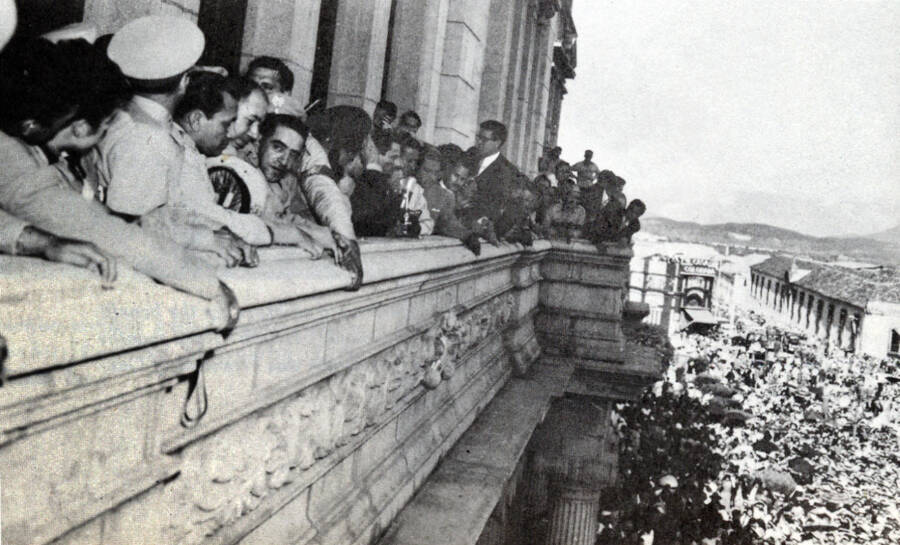
Aerial view of Guatemala City circa 1954, illustrating the changes following the coup d'état.
The 1954 Guatemalan Coup: Unveiling Operation PBSUCCESS
One of the earliest examples of U.S.-backed regime change, the 1954 Guatemalan coup reveals a tale of power, deception, and international meddling. Initiated by the CIA under Operation PBSUCCESS, this covert action removed a democratic leader and laid the groundwork for further Cold War interventions.
What Happened
Tuesday, June 27, 1954. Guatemala City was shrouded in an oppressive silence, a quiet before the storm that marked the end of a dramatic chapter and signaled the onset of a tumultuous new era. President Jacobo Árbenz, once a symbol of democratic promise in Central America, was staring down an almost invisible enemy. This enemy was not the populous dissent, not a military uprising born out of national discontent, but a foreign-crafted insurrection with roots dug deep into the halls of American power.
The genesis of this plot was sewn in Washington, D.C., amidst the fervor of the Cold War. In August 1953, President Dwight D. Eisenhower authorized a covert operation with the innocuous name of PBSUCCESS, with strategic oversight falling under the vigilant eye of CIA Director Allen Dulles. But beneath the cloak of this sterile title lay ambitions as turbulent as the period itself. Eisenhower, spurred by a mixture of anti-communist fervor and political necessity, saw in Árbenz's policies more than just agrarian reform — he saw the red specter of communism spreading across Latin America.

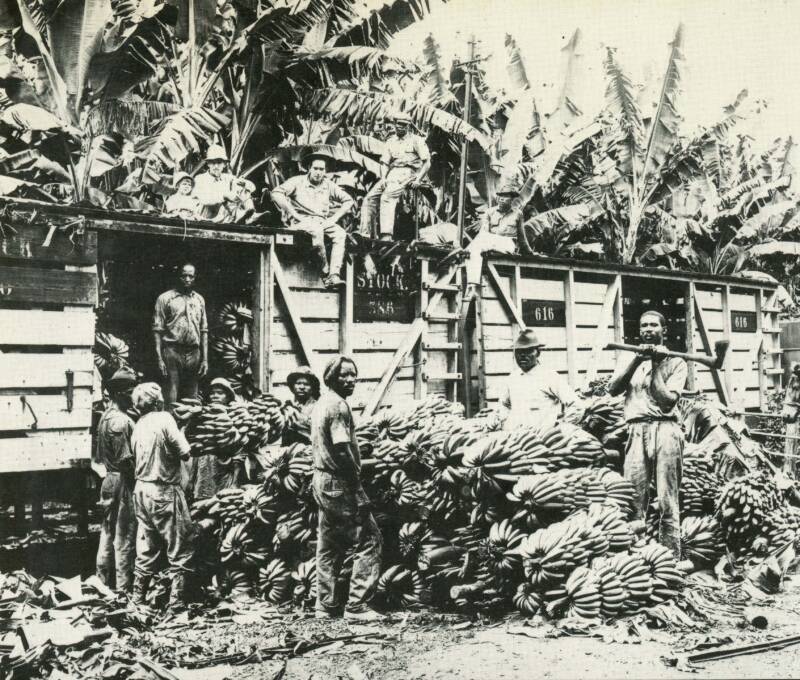
The immediate catalyst for action was Árbenz's ambitious agrarian reform law, which aimed to redistribute land to impoverished rural peasants. A noble cause seemingly, but one that trampled the interests of the United Fruit Company (UFCO), a powerful American corporation with extensive plantations lying fallow in Guatemala. UFCO, feeling its profitability and influence in jeopardy, leveraged its connections with the U.S. government, drumming up fears that the reforms were a conduit for Soviet influence.
With a budget of $2.7 million — a sizeable sum for the era — PBSUCCESS was greenlit, its mission clear and ruthless: propaganda, political action, and subversion were weaponized to topple a democratically elected government. Carlos Castillo Armas, a disgraced military officer looking for redemption and power, was anointed as the executor, poised at the helm of a CIA-molded force of 480 men ready to march from exile into the annals of Guatemalan history.

As this operation unfolded, the art of warfare extended beyond swords and guns into the realm of psychological warfare. The 'Voice of Liberation', a radio broadcast steeped in deception, echoed through the airwaves, portraying a nation teetering on the brink of civil unrest, a façade manufactured to demoralize the Árbenz regime and its supporters. Guerrilla attacks were staged, false intelligence fed to both domestic audiences and the international community, sowing chaos and doubt. The consequence was palpable; fear gripped the political elite, military morale waned, and the very fabric of national unity began to fray.
By late June 1954, the meticulously crafted spectacle of despair and inevitability bore fruit. Árbenz was abandoned by his military, cornered by international pressure, and emotionally exhausted by the psychological and political onslaught. He resigned, seeking asylum in Mexico, marking what seemed to be a bloodless resolution, a victory for U.S. interests.

But beneath the surface of this facade of triumph lay the seeds of discord that would eventually erupt into a catastrophic civil conflict. From the ashes of Árbenz's leadership rose Castillo Armas, not a beacon of democracy but a dictator who chained Guatemala to decades of military rule and violent suppression. This moment in history is not simply an echo of past imperial ambition; it is a resonant bell whose toll continues to warn against the hubris of unchecked power.
Timeline of Key Events

1953 — President Eisenhower authorizes Operation PBSUCCESS.
August 1953 — Operations Coordinating Board directs the CIA to proceed with plans against Árbenz.
Late 1953 — CIA begins training exile force led by Carlos Castillo Armas.
February 1954 — Propaganda operations are initiated against the Árbenz government.
March 1954 — Public opposition to Árbenz's land reforms is heightened through CIA-backed media.
May 15, 1954 — The U.S. imposes an arms embargo on Guatemala as a pressure tactic.
May 24, 1954 — Castillo Armas and his forces enter Guatemala from Honduras.
June 18, 1954 — Castillo Armas's forces close in on Guatemala City.
June 27, 1954 — Jacobo Árbenz resigns and seeks asylum.
July 1954 — Carlos Castillo Armas assumes power in Guatemala.
1955 — A purge of suspected communists begins in Guatemala.
1956 — Árbenz lives in Mexican exile, unable to return.
1960 — Long-term civil war breaks out as leftist groups rise against the government.
1963 — Castillo Armas is assassinated, illustrating further instability.
1970 — Intensified violence and civil war grips Guatemala.
1982 — Height of human rights violations in Guatemala.
1996 — Peace accords are signed, ending the 36-year long civil war.
2003 — Declassified documents reveal more about PBSUCCESS.
2011 — CIA acknowledges its role during a National Security Archive declassification.
2013 — Árbenz's remains are returned, and a symbolic apology is issued to his family.
What Is Documented
Operation PBSUCCESS stands as a pioneering example in the annals of American covert actions, meticulously documented through now-declassified CIA records and National Security Archive documentation. Authorized by President Eisenhower in 1953, the operation was a direct response to perceived communist encroachments in America's backyard, a selfish yet not entirely baseless paranoia that characterized early Cold War policy.
The CIA's plan was intricate, involving not just brute military force but a sophisticated campaign of psychological warfare and subversion. Declassified documents outline a budget of $2.7 million, dedicated to manipulating public opinion and fostering an environment conducive to revolt against President Jacobo Árbenz. The operation's commanders orchestrated a multifaceted approach: radio broadcasts from the 'Voice of Liberation', carefully curated press releases, and the dissemination of false information painted Árbenz as both inept and tyrannical.

Allen Dulles, the CIA Director at the time, was a central figure in the plot. Under his leadership, the Agency painstakingly trained a paramilitary force in Honduras, commanded by Carlos Castillo Armas, an opportunistic military officer whose personal history was as complex as the operation itself. Declassified National Security Archive records describe how this force crossed into Guatemala, bolstered by intelligence that manipulated military loyalties against Árbenz.
A further layer of intrigue is revealed in the corroborated reports of the involvement of key American corporations and their ties to the U.S. government. The United Fruit Company, with deep economic stakes in the region, played an influential, if unofficial, role. Documents released in the 2000s highlight how UFCO advocated fiercely against Árbenz, painting his reforms as dangerous socialist impositions.
The consequences of these documented efforts were immediate and long-lasting: the overthrow of Árbenz not only altered Guatemalan politics but signaled the viability of using covert means to achieve geopolitical goals — a grim precursor to subsequent U.S. interventions across Latin America and beyond.
What Has Been Alleged
While the overt operations of PBSUCCESS are well-documented, allegations surrounding its more insidious elements have emerged over time, painting a picture of corporate manipulation and moral ambiguity. Scholars like Stephen Schlesinger and Stephen Kinzer have long speculated about the underlying motives agitating U.S. interests in Guatemala, suggesting deeper commercial ties between political and economic spheres.
Central to these allegations is the role of the United Fruit Company (UFCO). Accusations have surfaced that UFCO utilized its enormous influence within American political circles to spark intervention. According to alleged reports and testimony from former UFCO executives disclosed in the decades following the coup, it became clear that their lobbying efforts painted Árbenz's policies as stepping stones to full communist control, cleverly disguising economic self-interest as ideological defense.
Furthermore, it has been alleged that the CIA's psychological warfare extended into ethically dubious territories. Allegations from various independent reports suggest the agency falsified information about guerrilla activities and violent uprisings, ensuring that chaos was palpable and relentless. Specific claims have accused the CIA of inventing stories of massacres and atrocities aimed at baiting elements of the Guatemalan military into revolt.
These acts, while not conclusively proven in their entirety, suggest a disquieting collaboration between corporate entities and state apparatus, reminiscent of the changing landscapes of international policy. Allegations also extend to claims of betrayal; promises of asylum for Árbenz's political allies were allegedly reneged, resulting in imprisonments and targeted assassinations. While these remain speculative without widespread tangible evidence, the persistence of these allegations underlines the still-contentious nature of PBSUCCESS in contemporary historical discourse.
What Remains Disputed
The narrative of Operation PBSUCCESS as articulated by official U.S. government accounts stands in stark contrast with multiple independent assessments, leading to ongoing disputes over the details and impacts of the 1954 coup. One critical point of contention is the supposed communist influence within the Árbenz administration. During the Cold War's heyday, American intelligence communities painted Árbenz as a proxy for Soviet interests. Yet, subsequent analyses by historians and political analysts have largely refuted this, arguing that Árbenz was primarily a nationalist leader with only minor ideological alignments to communism.
Official U.S. records initially touted the coup as a necessary action to remove a burgeoning authoritarian threat, asserting the operation's smooth execution as a textbook example of safeguarding democracy. Conversely, testimonies from Guatemalan survivors and documentation gathered by human rights organizations present a more turbulent picture, rich with coercion and conflict. These accounts describe systemic violence and suppression of civil liberties that were ignored or minimized in official American depictions of the events.
Post-coup portrayals by U.S. media suggested an abrupt restoration of stability and prosperity under Castillo Armas. However, subsequent investigations highlight that this perceived stability was superficial; the foundations laid during the coup catalyzed broader socio-political upheavals, marked by repression and brutality that led to decades of civil war.

These disputes underscore a broader struggle to interpret historical events through the lens of the divergent ideological perspectives of the Cold War era, a dichotomy that continues to color interpretations of U.S. interventions even today.
What Was Later Confirmed
Initially clouded in secrecy and denial, key aspects of Operation PBSUCCESS found confirmation through the eventual release of declassified documents and public acknowledgments by U.S. agencies. A watershed moment occurred in 1997 when the CIA declassified a tranche of documents that decisively verified the details of the Agency's involvement in orchestrating the coup.
These documents shed light on the specifics of the psychological operations — notably, the 'Voice of Liberation' broadcasts. At the time, the operations were presented as part of an organic resistance, but the declassified information later proved these were carefully constructed CIA operations intended to destabilize the Árbenz government by fabricating fear and dissent within the population and military ranks.
Further disclosures via National Security Archive publications illustrated the extent and sophistication of the logistical support coordinated by the CIA. This included aerial reconnaissance and dispersal of propaganda, affirming that these operations were far from grassroots efforts but part of a larger orchestrated strategy by a foreign intelligence agency.

A significant portion of these revelations focused on the role played by then-CIA Director Allen Dulles and his network of operatives, whose harrowing influence further legitimized accounts of the operation's complex implementation. Such acknowledgments have forced a re-evaluation of PBSUCCESS, transforming once heretical claims into acknowledged facets of a broader narrative about U.S. foreign interventionism.
Common Myths & Exaggerations
An array of myths linger around the events of 1954, often coloring public perception of Operation PBSUCCESS to this day. One such myth suggests that the coup was an organic uprising born of widespread national discontent with Árbenz, a notion unfounded when juxtaposed with historical records which delineate its orchestration by the CIA.
There is also a persistent, yet unsupported, belief that Árbenz was indeed a communist puppet, a claim propagated by cold-war era rhetoric but contradicted by post-coup analyses that portray his administration as a nationalist government seeking progressive land reforms.
A misconception persists that the coup ushered in immediate peace and restored democracy in Guatemala. In fact, the ascension of Carlos Castillo Armas gave rise to an era of autocratic rule, leaving a legacy of violence and human rights abuses.
Moreover, exaggerated narratives suggest that U.S. military forces were extensively deployed on Guatemalan soil. In reality, the operation relied less on overt military deployment and more on manipulative psychological tactics.
Dismissing these myths is critical for an accurate understanding of both the specific events and the broader implications of Cold War-era U.S. foreign interventions.
Why It Matters
The reverberations of Operation PBSUCCESS extend well beyond its initial geopolitical context, embodying a pivotal juncture in the evolution of cold war strategies that continue to inform international relations. The coup established a stark precedent for U.S. involvement in regime changes across the globe, marking a transition from isolationist policies to active, often aggressive, interventions in sovereign nations' politics under the guise of anti-communism.
The intervention in Guatemala is a textbook example of the lengths to which U.S. policymakers would project military and covert influence to achieve ideological supremacy, a strategy that later echoed through fiascoes in Vietnam, tensions in Cuba, and destabilizing coups in countries like Iran and Chile.
PBSUCCESS left an indelible scar on Guatemala's socio-political fabric, sowing decades of civil unrest and authoritarianism, deeply fracturing civil structures and economic stability. The long-term consequences underscore the often-overlooked human cost of interventionist policies, influencing generations and contributing to widespread violence and social upheaval.
Furthermore, the operation has raised significant questions about intelligence agency oversight, transparency, and accountability — issues pertinent to current debates over foreign policy strategies and military interventions by world powers. The episode highlights the risks inherent in clandestine operations, spotlighting the ethical implications of prioritizing strategic objectives over international legal norms and human rights considerations.
Recognizing the historical significance of PBSUCCESS is vital, not just as a cautionary tale of Cold War excess but as a continual marker for reflection and critique as contemporary global challenges demand fresh insights into the overarching narrative of international diplomacy and covert operations.
Connections to Other Archive Entries
The strategies and outcomes of Operation PBSUCCESS are frequently compared with other U.S.-sponsored coups, such as the 1953 overthrow of Iranian Prime Minister Mohammad Mosaddegh via Operation Ajax. Both cases showcase a similar tactical approach that interweaves military force with psychological tactics to achieve political objectives favoring U.S. interests.
Within Latin America, the Guatemalan operation prefigured further acts of CIA involvement, such as the 1973 coup in Chile that toppled President Salvador Allende. This perpetuation of regime changes underscores a pattern of interventionist policies that prioritized perceived threats over democratic principles.
These intersecting narratives of CIA manipulations during the Cold War illuminate broader historical trends of American foreign policy, highlighting how tactics refined in Guatemala were deployed in later operations, forming a template for both territorial control and overseas influence, lessons that continue to resonate in contemporary intelligence practices and foreign policies.
Sources & References
PRIMARY SOURCES
SECONDARY SOURCES
The Hidden History Archive is part of The Beacon Wire entertainment and informational platform. All archive articles are based on public sources, declassified documents, court records, and reputable journalism. Facts are clearly separated from allegations, disputed claims, and unsupported speculation. Nothing in this archive should be interpreted as legal advice or as incitement to harm. Readers are encouraged to consult primary sources directly.
We use cookies to improve your experience and analyze site usage. See our Cookie Policy for details.