
Italian Prime Minister Giulio Andreotti addresses the parliament in 1990, confirming the existence of Operation Gladio, a covert network during the Cold War.
The Secret Armies of Operation Gladio: NATO’s Hidden War Machines
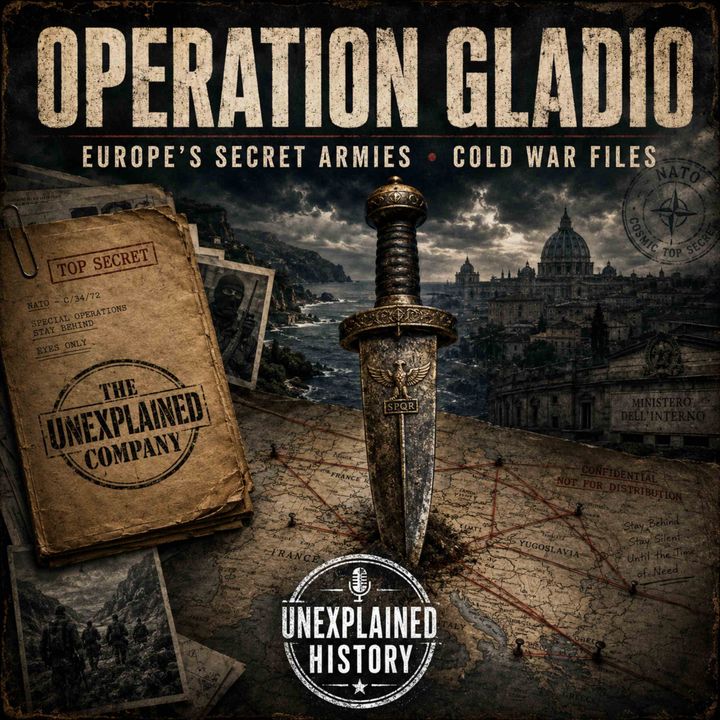
In the shadows of the Cold War, NATO orchestrated a clandestine network known as Operation Gladio. This shadowy initiative prepared for a Soviet invasion by establishing secret stay-behind armies across Europe. The legacy of these hidden networks raises unsettling questions about military secrecy and Cold War paranoia.
What Happened
It was a time when the dread of a Soviet dawn loomed upon Western Europe. Secret plans were concocted in dimly lit rooms far from prying eyes. One startling operation, running under the radar for decades, was Operation Gladio. Established during the tense rhetoric of the Cold War, Gladio was designed as a covert network of 'stay-behind' armies, poised to resist potential Soviet incursions.
To comprehend Gladio, we must step back to its inception in the late 1940s. The ashes of World War II were still smoldering when Western governments foresaw new threats on the horizon. The specter of communism loomed large, and paranoia bred preparation. Under the auspices of NATO and aided by the CIA and British MI6, a clandestine network came alive. It was essential to maintain a European stronghold if the Red Army began its march westward.

These secret armies stockpiled arms, munitions, and sometimes recruited from the remnants of fascist regimes. Italy became the focal point of these efforts. The country not only bordered the Eastern Bloc but also harbored a potent communist movement. In Italy, the deep ties between Operation Gladio and notorious political groups blurred the lines, making the public realm a chessboard for unseen players.
The coordination within NATO countries was instrumental. Officially, these units were invisible, operating independently yet guided in the shadows by NATO’s strategies. The soldiers of these auxiliary armies often lived civilian lives, their true identities shielded by layers of secrecy.
Yet the very foundations of secrecy that supported Gladio also became its Achilles’ heel. The implications of these covert operations surfaced through an array of investigations, parliamentary inquiries, and declassified documents. Reports surfaced in the 1990s, revealing the vast web spun across Europe.
Questions about the unchecked power yielded by these clandestine forces and their true objectives remain unanswered, yet their legacy echoes through contemporary dialogues on governance and accountability. To understand the full breadth of Gladio is to gaze into the abyss of military stratagems and machinations that defined an era.

Timeline of Key Events

1940 — Winston Churchill orchestrates Special Operations Executive in Britain, laying the groundwork for future stay-behind networks.
1951 — Establishment of clandestine units under Operation Gladio begins in Italy.
1956 — French military intelligence becomes involved in coordinating stay-behind networks.
1961 — NATO formally adopts a stay-behind policy, concealing these networks from national governments.
1964 — Operation Gladio cells expand into more Western European countries amid increased Cold War tensions.
1972 — The Italian authorities find weapons caches linked to Gladio but investigations are inconclusive.
1974 — Italy experiences political turmoil, and Gladio's role comes under scrutiny in antigovernment protest narratives.
1984 — Switzerland's P-26 network links are discovered, tied to NATO's Gladio operations.
1990 — Italian Prime Minister Giulio Andreotti confirms Gladio's existence to the Italian Parliament.
1990 — Belgian government launches an inquiry into its own stay-behind operations after the Gladio revelations.
1990 — French President François Mitterrand acknowledges the presence of stay-behind networks on French soil.
1990 — The European Parliament calls for an inquiry into the countries' involvement with Operation Gladio networks.
1992 — Switzerland formally disbands its stay-behind army under public scrutiny.
1995 — A comprehensive Italian parliamentary investigation reveals ties between Gladio and acts of political violence.
2000 — The European Union releases findings on stay-behind armies, urging transparency and dismantlement.
2004 — Declassified documents reveal CIA's extensive involvement in setting up these networks.
2005 — Investigative reports unveil connections between Gladio networks and unsolved political assassinations in Europe.
2011 — Italian historical commissions continue debating the true extent of Gladio's influence on domestic terrorism.
2014 — New documents suggest British MI6's continued role in managing stay-behind elements post-Cold War.
2020 — Historians unveil previously classified NATO documents detailing the breadth of Gladio's scope in Western Europe.
What Is Documented
Operation Gladio remains one of the most disturbingly intricate webs spun during the Cold War, documented extensively through a slow trickle of declassified papers and official admissions. Initially devised by Winston Churchill in 1940 as the Special Operations Executive, the stay-behind concept was perfected and implemented across several European nations as tension with the Soviet Union escalated.
The core of Gladio, as revealed in Italian parliamentary records from 1990, revolved around clandestine paramilitary units operating with NATO's covert blessing. These units were structured to become guerrilla forces in the event of a Soviet occupation, their existence often hidden from the respective countries’ governments themselves.

It wasn't until Italian Prime Minister Giulio Andreotti publicly confirmed Gladio's presence to the national parliament in October 1990 that the international community began to unravel its complexities. He detailed how NATO oversaw operations, supplying arms and intelligence, while also laying bare cases of political manipulation against domestic communist threats.
European parliamentary inquiries and national investigations, most notably in Belgium and Switzerland, verified that these networks extended to nearly all NATO countries. The discovery of weapons caches and corroboratory testimony highlighted these networks’ vast expanse and operational depth.
Substantial CIA collaboration has been affirmed through declassified U.S. State Department documents, which detailed logistical and strategic support provided to align these secret armies with broader Western defense strategies. Official responses from NATO, when confronted by these inquiries, often deflected with diplomatically worded acknowledgments of 'contingency planning,' never fully embracing public transparency.
What Has Been Alleged
The shroud of secrecy that envelops Operation Gladio has, predictably, bred a multitude of allegations, some grounded in partial truths, others swirling in conjecture. Critics argue, with varying levels of supporting evidence, that Gladio operatives were involved in false flag operations designed to undermine the Left in Europe, notably influencing terrorist activities in Italy during the so-called Years of Lead.
Italian magistrate Felice Casson, spearheading investigations in the late 1980s, ignited allegations that Gladio soldiers were complicit in orchestrating bombings and assassinations to escalate anti-Communist sentiment. Many of these claims contended that right-wing extremists within Gladio intentionally distorted public perception to justify authoritarian crackdowns.
Such theories were bolstered by testimonies from former operatives themselves. Vincenzo Vinciguerra, a far-right extremist convicted of murder, testified in court that the aim of certain attacks, for which he claimed responsibility, was to manipulate political landscapes via orchestrated chaos.

Despite these claims, notable lacunae persist within the investigatory corpus, largely due to the classified nature of many documents and the unwillingness of surviving international organizations to fully disclose detailed archives. Italian journalist Leo Sisti, in his extensive examination, points to confessions obtained under duress and a dearth of corroborating physical evidence as factors muddling the legitimacy of certain accusations.
As a result, while these allegations remain powerful narrative forces, they do not occupy the solid ground of 'conclusive proof.' Rather, they illustrate the entwined complexities and enduring shadows cast by resources and machinations hailed as necessary for national security at the time.
What Remains Disputed
Operation Gladio's shadowy past has given rise to considerable disputes between official accounts and the theories advanced by independent researchers. One of the most contentious elements involves the extent to which Gladio and similar operations were responsible for instigating acts of domestic terrorism.
Official accounts, as noted in declassified NATO documents, maintain that the stay-behind networks were intended strictly for defensive maneuvers against potential Soviet occupation. They assert that there was no sanctioned operation aimed at domestic interference or voter manipulation.
Contrarily, numerous researchers and journalists, such as Daniel Ganser, challenge this narrative with claims that Gladio had a hand in domestic destabilization efforts, proof of which, they argue, lies in the similarity of patterns across multiple countries where politically motivated violence had conspicuously aligned with Gladio's operational timelines.

Italian magistrates during the 1990s investigations unearthed testimonies suggesting orders were received from above to orchestrate fear-based campaigns. However, NATO repeatedly denied authorizing any such actions, labeling deviations from standing protocol as rogue factions.
The persistent divergence between NATO's statements and independent findings highlights the complexity surrounding Gladio's historical narrative. This has made it a perennial subject of analytic scrutiny, underscoring the enduring challenge in balancing national secrecy against public accountability.
What Was Later Confirmed
Operation Gladio, once a subject of staunch denial, saw many of its facets confirmed with the gradual release of declassified documents through government transparency initiatives. Notably, the existence and strategic intentions of Gladio were confirmed after decades of official denials, thanks to dedicated researchers and whistleblowers whose persistence in seeking transparency eventually paid off in the 1990s.
In Italy, the turning point was Prime Minister Giulio Andreotti's statement to parliament, where he admitted to the existence of these networks. This admission set off a cascade of confirmations across other involved nations, pressuring bureaucracies to reluctantly acknowledge similar operations within their borders.
Belgium and Switzerland were among the countries whose own investigations corroborated NATO's involvement in clandestine operations. A 2000 European Union investigative report further cemented these confirmations, providing a breakdown of networks and operations across participating countries.

The CIA's role, masked for so long, was laid bare through a series of declassifications under the Freedom of Information Act, revealing a complex web of coordination with NATO that had extended far beyond simple defensive preparations. These documents illustrated the intricate planning and, at times, troubling alliances that underpinned Gladio.
Such confirmations not only substantiated what had been alleged but also raised deeper questions about the ethical and legal implications of such covert operations in democratic societies.
Common Myths & Exaggerations
Numerous myths and exaggerations have surrounded Operation Gladio over the years, fueled by its clandestine nature and the consequent scarcity of open documentation. One pervasive myth involves a purported global conspiracy orchestrated by the secret networks to control entire governments, a notion largely unsupported by any concrete evidence.
Some narratives falsely claim that every act of late 20th-century terrorism in Europe could be traced to Gladio conduits. While the operation's fingerprints have been reliably spotted in certain elements of political turmoil, these assertions vastly overestimate its reach and cohesion, ignoring a multitude of other geopolitical factors and actors.
A common exaggeration posits that the stay-behind networks were fundamentally anti-democratic entities poised for civilian coups. This has been debunked as an oversimplification. Gladio’s primary goal was the rapid assembly of a resistance network, a fact sometimes sensationalized by critics who conflate operational planning with ideological intent.
While Gladio certainly engaged in questionable practices, documentation shows that no blanket mandate for electoral interference existed. Distinguishing between actions by individual operatives and sanctioned network objectives is crucial to understanding the nuanced reality of these covert operations.
Why It Matters
The revelations and ongoing controversies surrounding Operation Gladio hold immense significance, both historically and in terms of current international political dialogue. They lay bare the paradoxes inherent in decisions made for national security purposes—decisions that can infringe on the very democratic principles they purport to safeguard.
By revealing NATO’s and Western allies’ capabilities to mobilize clandestine operations, Gladio serves as a cautionary tale about unchecked power and secrecy within military alliances. It highlights the enduring tensions between security, privacy, and transparency—issues as relevant today amidst fears of domestic surveillance and cyber warfare as they were during the Cold War.
The operation set a precedent for secret military preparations deployed on a civilian landscape, challenging the boundaries of legitimate defense strategies. These precedents continue to inform debates on military oversight and the intelligence activities directed at perceived internal threats.
Contemporary parallels can be drawn with ongoing discussions about covert activities conducted in the name of national security, be they drone strikes, data monitoring, or informational warfare. As democracies attempt to balance security against civil liberties, Gladio’s legacy presents a provocative case study on the necessary safeguards and debates that must accompany governmental power in the shadows.
Ultimately, examining Gladio is quintessential to understanding the invisible apparatuses that function beneath visible political maneuverings, reminding citizens of their crucial role in demanding accountability and transparency from their leaders.
Connections to Other Archive Entries
Operation Gladio is intricately connected to a wider tapestry of Cold War activities and controversies. Similar in secretive nature and international reach, it parallels other covert operations like Operation Paperclip and the CIA's MKUltra project. These programs collectively illustrate an era when geopolitical fears justified extreme and often ethically disputed measures.
In exploring Gladio, one also finds traces linking to the broader narrative of Western interference in domestic politics worldwide—an indirect cousin to the Iran-Contra affair, where allegiances and militaristic strategies muddy the waters of ethical governance.
The covert mechanisms seen in Gladio’s logistics and alliances reflect foundational themes present in The Beacon Wire's coverage on 'The Secret Cold War Playbook', exploring how strategic shadows shaped global trajectories. As we sift through these stories, Gladio continues to resonate within the discourse of militarization and political influence under the guise of security preparedness.
Sources & References
PRIMARY SOURCES
SECONDARY SOURCES
The Hidden History Archive is part of The Beacon Wire entertainment and informational platform. All archive articles are based on public sources, declassified documents, court records, and reputable journalism. Facts are clearly separated from allegations, disputed claims, and unsupported speculation. Nothing in this archive should be interpreted as legal advice or as incitement to harm. Readers are encouraged to consult primary sources directly.
We use cookies to improve your experience and analyze site usage. See our Cookie Policy for details.