
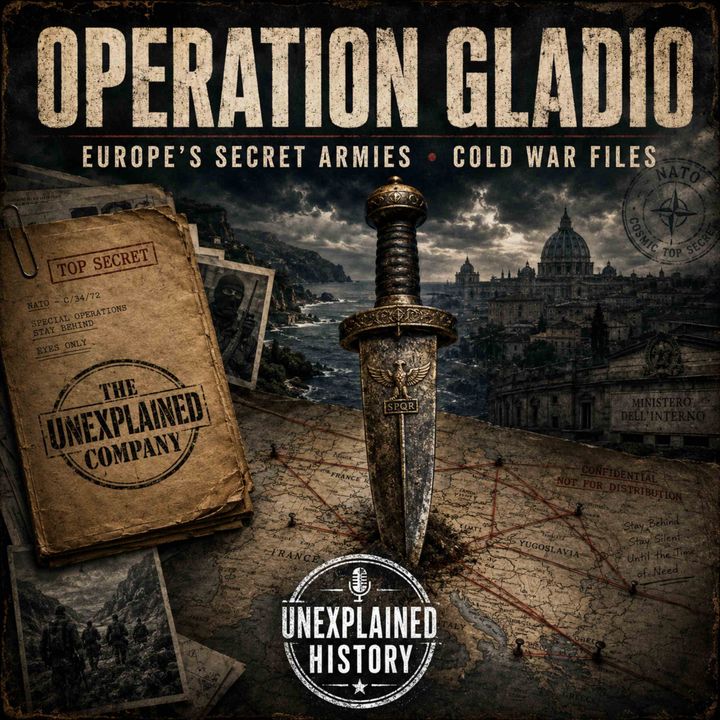
Gladio operatives in a secret briefing meeting, ca. 1960s.
Operation Gladio: Unveiling NATO’s Secret Cold War Armies
During the Cold War, NATO orchestrated a clandestine network of paramilitary groups known as Operation Gladio. This secret army was designed to resist potential Soviet aggression in Europe. However, declassified records reveal a murky connection to political unrest and coups, raising critical questions about Cold War operations and their hidden influence on global politics.
What Happened
In the shadowy depths of post-World War II Europe, a sinister and highly secretive operation unfolded—Operation Gladio. It was the late 1940s, a grim era when geopolitical tensions brimmed with paranoia. An invisible grip extended through the continent, ostensibly to defend against a full-scale Soviet invasion. This clandestine network of 'stay-behind' paramilitary groups, embedded within NATO countries, reveals a tangled web of covert activities that would dramatically reshape the political landscape.
The Cold War was not just a period of overt arms races and public political rhetoric; it simmered with covert operations and hidden alliances. As Europe lay shattered and vulnerable after the war, the perceived communist threat loomed large. The Western Union, which later evolved into NATO, hatched the idea of Operation Gladio. The aim? To prepare anti-communist resistance fighters, dubbed 'stay-behind' armies, who would spring into action should the Iron Curtain advance across the continent.
This plan was not merely theoretical. NATO countries, alongside their intelligence counterparts like the CIA in the United States and MI6 in the United Kingdom, actively recruited, trained, and equipped these secret armies. Weapons were stockpiled, and communications networks were established in deep-hidden bunkers from Britain to Turkey. These armies weren't merely on standby; they were meticulously organized, each cell ready to function autonomously in a crisis.
However, as the years rolled on, the operations of Gladio transcended its original defensive intent and seeped into more insidious undertakings. Allegations began to surface about these networks' involvement in domestic terrorism. Operations in Italy, Belgium, and other nations were linked to mysterious bombings and political assassinations, causing whispers of potential deep-state manipulation designed to sway public sentiment against communism.

It wasn't until the early 1990s that these secrets started to unravel. A tumultuous wave of scandal broke in Italy, where investigations into the country's secret service unearthed Gladio's existence. The revelations appalled Europe, sparking parliamentary inquiries and feeding already rampant conspiracies about the extent of state-sponsored networks' involvement in destabilizing left-leaning governments.
What was conceived as Europe’s clandestine bulwark against Soviet domination revealed a darker underbelly of political manipulation and murky alliances. Operation Gladio serves as a chilling example of how state security operations can blur the lines between national defense and manipulation of civilian perception.

Timeline of Key Events
1948 — The Western Union forms, laying conceptual groundwork for stay-behind networks.
1949 — NATO is founded; discussions of covert operations against Soviet expansion begin.
1956 — Secret directives creating 'stay-behind' units are developed in multiple NATO countries.
1966 — Italian General Giovanni de Lorenzo accused of using Gladio network in a planned coup.
1969 — Piazza Fontana bombing in Milan; Gladio network later implicated in connection.
1974 — Investigations into the Italian military services reveal shadowy Gladio connections.
1978 — Aldo Moro is kidnapped; his murder intensifies scrutiny of secret state operations.
1980 — Bologna Massacre; inquiries suggest Gladio might have orchestrated the attack.
1990 — Italian Prime Minister Giulio Andreotti officially acknowledges Gladio’s existence.
1990 — Belgian Senate commences investigations into the country's stay-behind networks.
1991 — European Parliament condemns Gladio, demanding details from member nations.
1995 — The Senate of Italy concludes the Gladio network was beyond parliamentary oversight.
2000 — Declassified CIA files reveal US involvement in Gladio operations.
2005 — Swiss historian Daniele Ganser publishes a critical review of Gladio networks.
2010 — A commission in Denmark investigates alleged Gladio activities within its borders.
2014 — New documents hint at continued US sponsorship of such networks post-Cold War.
2019 — Researchers reveal potential stay-behind operations influencing modern geopolitics.
2020 — Italian courts declassify additional Gladio-related documents to public access.
2023 — Belgium reopens inquiries into unresolved cases attributed to Gladio.
2026 — Academic consensus remains divided on Gladio networks' modern implications.
What Is Documented
As the murky veil of military secrecy gradually lifted, Operation Gladio stood exposed through various declassified documents and official admissions. One such pivotal moment came in October 1990 when Italy's Prime Minister Giulio Andreotti publicly accepted the existence of Gladio, describing it as a 'deviation' from intended democratic safeguarding procedures. This admission catalyzed parliamentary investigations across Europe, unearthing a trove of once-clandestine operations.
Specific declassified materials, such as the 1992 document from the Italian Senate, explicitly detailed the structure and functioning of Gladio networks. Documents revealed a robust subsidy from the CIA and entwinement with local militaries to foster underground resistance movements. It was no longer a question of if these networks existed, but rather how deeply they were embedded in the political and social frameworks of NATO countries.

Further declassified State Department cables pointed towards the founding intent: to prepare civilian resistance units capable of guerrilla warfare against any Soviet invasion. These documents showcased the meticulous installation of hidden weapons caches throughout Europe, especially in countries like Switzerland and Germany, where terrains favored clandestine resistance operations.
The European Parliament's 1990 resolution is another documented landmark. It censured secret armies operating under NATO's oversight, demanding full transparency and dismantling any remaining structures. Though the resolution lost much of its legal bite in the face of sovereign operation rights, it underlined the factual basis of Gladio's extensive reach.
Names like General Giovanni de Lorenzo and William Colby went down in history with glowing, yet ominous roles. De Lorenzo is documented within Italian military records as a key figure in integrating Gladio operatives into high-stakes positions for potential coups. Across the Atlantic, CIA records affirm William Colby's involvement in facilitating operational logistics during his European assignments in the 1950s.
To historians and political analysts alike, these comprehensive records depict not just a narrative of shadowy Cold War defenses but an alarmingly proactive manipulation of European political affairs that continues to haunt the socio-political realm today.
What Has Been Alleged
The shadowy operations of Gladio are rife with unproven allegations that plunge deep into conspiracy territory. A prevailing claim hinges on the Gladio network's involvement in domestic terrorism, notably attributed to left-wing entities. These networks, some allege, orchestrated false-flag attacks such as bombings and assassinations, aiming to shift public sentiment towards right-leaning governments.
In Italy, the Piazza Fontana bombing of 1969 remains one of the starkest allegations against Gladio. Critics like former Italian President Francesco Cossiga have insinuated that the network incited such violence to undermine communist influences. Accusations in literature and media, such as the work of journalist Philip Willan, allege direct CIA complicity in these insidious activities, although these assertions linger without full judicial corroboration.
Belgian politician Hugo Coveliers voiced concerns about similar unnerving activities. Allegations surfaced about state-sponsored networks creating chaos to justify expansive anti-communist measures. Coveliers and other critics argue a deliberate pattern of destabilization, echoing through propagandistic undertakings masked as national security.

Further allegations point to supposed ideological manipulation orchestrated through educational and media spheres. Some believe that certain universities and television stations subtly seeded conservative propaganda through covert Gladio influence. Although occasional anecdotes from defectors or lapsed operatives tempt belief, concrete proof remains elusive.
The late 2000s saw renewed allegations surfacing through books and documentaries, insinuating that remnants of these networks lingered, potentially influencing post-Cold War foreign policy decisions. Anonymous diplomatic sources hinted at Gladio's legacy in shaping recent NATO expansions and counterterrorism agendas.
Despite fervent assertion of these claims by some historians and activists, the absence of irrefutable documentary evidence or legal rulings leaves Gladio — and its alleged machinations — steeped in layers of speculative intrigue.
What Remains Disputed
Disputes over Operation Gladio are as contentious as the network itself. At the core is the claim of intentional state-sponsored terrorism by these clandestine networks, a notion that divides official accounts and independent researchers.
While Italian courts have occasionally inferred connections between Gladio operatives and certain violent events like the Bologna massacre, formal judicial decrees fell short of confirming state directives behind the attacks. Official Italian inquiries often attributed the violence to independent extremist groups without conclusive ties to Gladio.
Independent researchers like Swiss academic Daniele Ganser argue vehemently that Gladio networks were deeply involved in violent episodes, influenced by broader political agendas. However, critics dismiss some of Ganser’s findings as speculative, asserting a lack of rigorous historical methodology.

Mainstream historians remain skeptical of all-encompassing narratives of covert state terrorism. Critics suggest that the networks were primarily precautionary, with double agents within rogue cells likely independently pursuing questionable plots without direct state sanction.
Across the Atlantic, the CIA categorically denies ordering European false-flag operations. Recent interviews from former agents contend that Gladio operations were strictly defensive, with unwarranted actions being isolated misjudgments by independent actors.
The split narratives leave Gladio shrouded in ambiguity, as official and investigative accounts continue to clash over motivations and agency in these shadowy operations.
What Was Later Confirmed
Several elements initially shrouded as mere conspiracy theories about Gladio gradually found confirmation through formal revelations and declassification. Notably, substantial links between military services and the Gladio network, vehemently denied for decades, were eventually acknowledged by multiple governments.
One significant shift came with Italy's 1990 public pronouncement. Prime Minister Giulio Andreotti's confirmation validated suspicions of a NATO-affiliated clandestine network operating within parliament's blindspot, a disclosure that reshaped European discussions around state sovereignty and democratic oversight.
Similarly, a 2000 disclosure by a former CIA operative, released through declassified channels, acknowledged the agency's role in orchestrating communication and coordination aspects of Gladio, strengthening European military ties against perceived Eastern Bloc threats. This safeguarding rationale was corroborated by credible case files available in US National Archives.

The Belgian Parliament’s wide-reaching inquiries yielded further confirmations in the late 1990s and early 2000s. Investigative reports detailed Gladio’s constitution as a standalone network, integrated with Belgium's military contingency frameworks, although remaining instruments of choice for any officially recorded domestic interference were disbanded around the Cold War’s conclusion.
Such confirmations, albeit enveloped in defensive language, confirm pivotal operation elements and participations once shielded under Cold War discretion. They brought into light the sheer scale and scope of coordinated, though publicly and legally controversial, transnational resistance plans.
Common Myths & Exaggerations
Operation Gladio is fertile ground for myths and exaggerations that often diverge from substantive evidence. One prominent myth purports that Gladio networks were universally engaged in terrorist activities, sowing chaos across Europe. However, while certain operatives may have engaged in violence, authoritative inquiries have not substantiated widespread systematic terrorism directed by Gladio central command.
Another myth exaggerates Gladio’s magnitude, portraying it as a monolithic conspiracy spanning all aspects of international relations in the West. In truth, while extensive, its scope was primarily tactical, related to countering specific military threats, rather than influencing daily political operations or media.
There is also a falsehood that Gladio network overlappings inherently bred organized crime, especially within Italian borders. While some associates held extralegal ties, no judicial process found definitive Gladio sanction behind criminal operations.
Often exaggerated, is the notion that Gladio helped elect and maintain specific political figures in power throughout Europe. While it supported anti-communist strategies, there is no documented evidence showing that it directly interfered in electoral processes.
These myths, many birthed from mistrust of Cold War espionage undercurrents, often distract from verifiable facts. Scrupulous historical analysis is essential to demarcate between fictional narratives and confirmed realities within clandestine operational histories.
Why It Matters
Operation Gladio carries profound historical significance that transcends its Cold War origins. It reflects the tensions between democratic transparency and militarized security in times of geopolitical threats. This duality continues to resonate as societies grapple with modern transparency issues amid counterterrorism drives.
Politically, Gladio set precedents on conditional state sovereignty within multilateral alliances. It highlighted the contradictions often experienced in maintaining national defense within larger security complexes like NATO. The network's existence and legacy posed critical questions about nation-state autonomy, echoing through twentieth-century tensions and even into twenty-first-century policy discourses.
The concept of 'stay-behind' strategies remains a reference point in military contingencies and theoretical defense-politics discourses. Modern resistance plans continue to examine Gladio’s experience to refine principles behind guerrilla networks, state reconciliation, and independent operational cells.
Civil liberties discussions also find roots in Gladio’s narrative. Operations conducted without parliamentary oversight catalyzed later European legal reforms aimed at reconciling intelligence secrecy with democratic accountability, influencing today's legislative discourse over privacy laws balancing security and personal freedom.
In modern geopolitics, as great-power tensions see renewed daylight, Gladio’s legacy underscores an enduring balancing act between fortifying alliance commitments and preserving transparent governance frameworks. It serves as a potent reminder of oversight imperatives in state operations, warranting ongoing critique and scholarly interest.
Connections to Other Archive Entries
Operation Gladio connects to several pivotal historical programs. The infamous CIA MK-Ultra project parallels Gladio in its veiled Cold War experimentation, reflecting intelligence communities' overarching methodologies during that era.
The various anti-communist campaigns, notably the McCarthy era's zealous pursuits within the United States, also resonate, highlighting the global obsession with containing perceived communist threats, an ideology that permeated Western political psyche throughout the 20th century.
Additionally, Gladio's structure unwittingly set groundwork guiding later NATO covert and overt military interventions during volatile periods like the Yugoslav wars in the 1990s. Its mode influenced modern insurgency frameworks visible in conflicts like Afghanistan and Iraq, where hybrid warfare and civilian-oriented resistances remain subjects of strategic investigation today.
Sources & References
PRIMARY SOURCES
SECONDARY SOURCES
The Hidden History Archive is part of The Beacon Wire entertainment and informational platform. All archive articles are based on public sources, declassified documents, court records, and reputable journalism. Facts are clearly separated from allegations, disputed claims, and unsupported speculation. Nothing in this archive should be interpreted as legal advice or as incitement to harm. Readers are encouraged to consult primary sources directly.
We use cookies to improve your experience and analyze site usage. See our Cookie Policy for details.