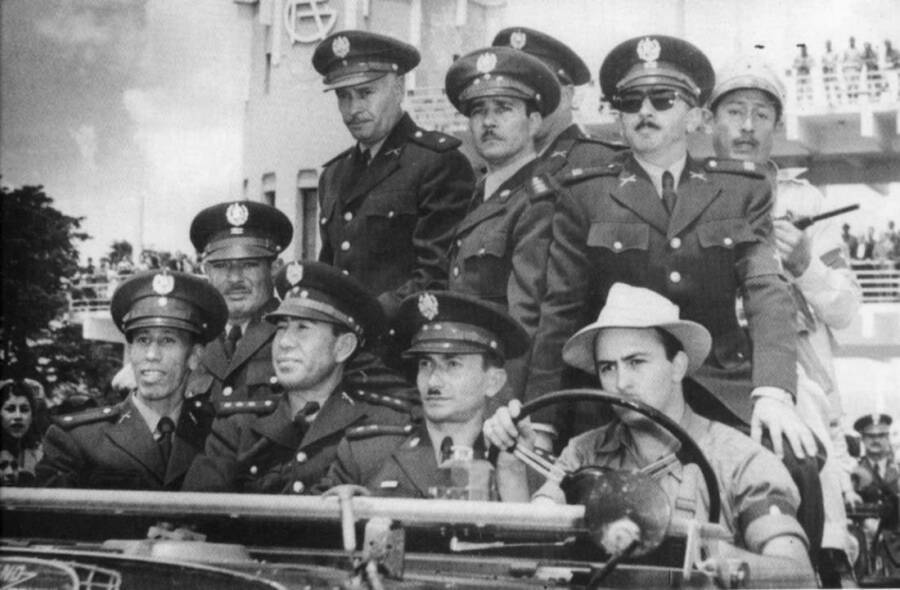
CIA operatives reviewing strategic maps during Operation PBSUCCESS, 1954, depicting a critical Cold War intervention moment.
Unveiling Operation PBSUCCESS: The Covert Coup in Guatemala That Changed a Nation Forever
In a decisive move during the Cold War era, the CIA orchestrated a coup that overthrew Guatemala's democratically elected President Jacobo Árbenz in 1954. This covert operation, known as PBSUCCESS, left an indelible mark on the nation's history and raised pressing questions about U.S. interventions, democracy, and foreign policy ethics.
What Happened
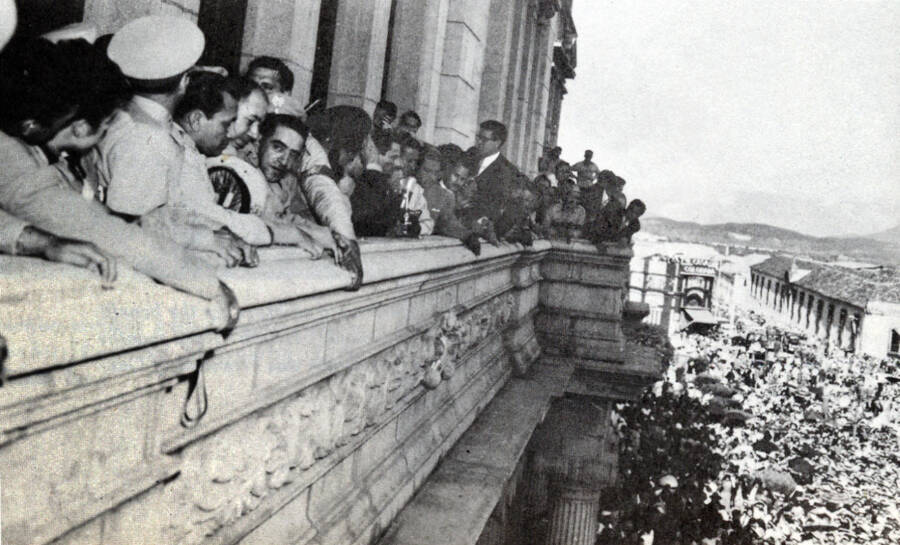
The oppressive heat of a Guatemalan summer was but a backdrop to what would become one of the most audacious acts of Cold War subterfuge. On June 27, 1954, an entire nation watched as President Jacobo Árbenz Guzmán, once a symbol of democratic reform, stepped down in a speech laced with despair and resignation. This wasn't just another shake-up in Latin America; it was the climax of Operation PBSUCCESS, a coup orchestrated by the CIA, marking a cataclysmic point in U.S.-led interventions. Árbenz had risen to power harboring a vision clear and ambitious — a Guatemala liberated from economic feudalism, where vast expanse agricultural lands, underutilized by multinational companies like the United Fruit Company, would instead feed and provide for the impoverished rural populace. Yet, to the Eisenhower administration embroiled in the throes of Cold War paranoia, Árbenz's reforms were seen not as progress but as a creeping threat of communist expansion. To the corporate giants, chiefly United Fruit, these reforms threatened profits and control cultivated under sunlit plantations but dictated from far-off boardrooms in America. The stage was set for an extraordinary intervention. With a $2.7 million budget, the CIA's masterstroke under Operation PBSUCCESS was to dismantle both Árbenz's government and the ideologies supporting it. The agency devised an intricate mix of propaganda, political strategy, and psychological warfare. They armed and empowered the ambitions of a vengeful Colonel Carlos Castillo Armas, a disgraced military figure yearning for return and revenge. The strategy ranged from crafting a fictional narrative in the media, labeling Árbenz a Soviet pawn, to executing clandestine actions that fostered disunity within his administration. False broadcasts declared imaginary invasions; leaflets incited fear, catalyzing a psychological tumult ensuring Guatemala's military would falter at arms. Swiftly, Castillo Armas led a meager force into battle, bolstered more by the fear of impending doom than by actual firepower. Within days, Árbenz, isolated and under siege, found his support eroded amid crumbling alliances and relentless pressure. His relinquishment on June 27 paved the way for Castillo Armas's ascendancy, yet with it came a regime predominantly characterized by repression, becoming a marionette under Washington’s influence. Thus opened a dystopian chapter for Guatemala, setting the stage for nearly four decades of bloody civil conflict. The promises veiled in Operation PBSUCCESS shattered into terrifying visions of genocide and an interminable power vacuum, narratives that still echo through the annals of Central America.
Timeline of Key Events
1952 — President Jacobo Árbenz initiates agrarian reforms targeting unused lands, facing fierce opposition from United Fruit Company.
1953 — Eisenhower approves Operation PBSUCCESS, marking a significant U.S. intervention to depose Árbenz.
March 1954 — The CIA orchestrates psychological warfare operations against the Árbenz administration.
May 1954 — Armed opposition is mobilized, training under Castillo Armas begins in earnest.
June 18, 1954 — The incursions spearheaded by Castillo Armas's forces commence.
June 25, 1954 — Árbenz makes a last-ditch appeal for unity amid plummeting defenses.
June 27, 1954 — Árbenz resigns amid severe pressure, paving the way for Castillo Armas.
July 8, 1954 — Castillo Armas assumes the presidency, initiating a period of repressive governance.
1955 — United Fruit Company regains its landholdings nullifying previous reforms.
1956 — Castillo Armas narrowly escapes assassination, underscoring persistent instability.
1957 — Castillo Armas is assassinated; political volatility escalates.
1960 — Formation of leftist guerrilla groups arises from mounting unrest.
1966 — U.S. amends its engagement strategy, deploying advisors amidst guerrilla tensions.
1976 — A devastating earthquake exacerbates Guatemala’s socio-economic crises.
1982 — Efraín Ríos Montt takes power amid intensified civil conflict and human rights abuses.
1996 — Comprehensive peace accords are signed, aiming to end the civil war.
1999 — UN commission implicates U.S. in contributing to approximately 200,000 deaths via civil conflict.
2003 — Detailed CIA records of Operation PBSUCCESS are declassified, revealing secret intricacies.
2011 — Árbenz's reformist efforts receive posthumous acknowledgement through historical reevaluation.
2020 — Ongoing debates on U.S. foreign policy recognize historic Latin American interventions like Guatemala’s coup.
2025 — Consensus solidifies regarding PBSUCCESS’s influence in prompting regional upheaval.
What Is Documented
The labyrinthine plot of Operation PBSUCCESS, illuminated through once-secret documents now declassified, is a telling testament to the intricate dance of geopolitics and aggression. Initiated under Eisenhower's directive in 1953, the operation was designed with a budget poised at $2.7 million — a figure befitting such deceptive undertakings. These funds fueled an array of coercive strategies: fostering destabilization through a strategic media blitz and orchestrating elaborate propaganda campaigns that seamlessly interwove fear and misinformation. Central to this effort was the support from the United Fruit Company, a powerful agricultural conglomerate whose roots were tangled deeply within the corridors of U.S. power. Notably, John Foster Dulles, the Secretary of State, was intricately linked to United Fruit as previous legal counsel, while his brother Allen Dulles, the CIA Director, remained an influential advocate. The exchange of influence and capital became a core facet of America's covert calculus. Official declassified communications underscore that the CIA's Office of Policy Coordination, crucial in 1953, exploited these connections to further psychological warfare. Scripts for incendiary broadcasts bore Washington’s fingerprints more clearly than Guatemalan sentiment, creating the illusion of indigenous rebellion. 'La Voz de la Liberación,' a strategic radio station, spurred dissension by broadcasting chaos and threatening — thereby galvanizing military defections under an umbrella of panic. Verified congressional documents have since confirmed this synthetic narrative and the CIA's corresponding manipulations. The unveiling of State Department narratives, previously opaque, cemented the dishonest denial of any involvement, further reiterated in posthumous acknowledgements and investigative unveilings that characterize Guatemala's historical tragedy.
What Has Been Alleged
Among the murky allegations swirling around Operation PBSUCCESS are claims of darker, unverified actions by the CIA throughout its execution. Critics, including historians and investigative journalists, suggest that the psychological manipulation was deliberate in its intent to spur violence against followers of Árbenz. Allegations include speculations of an 'Operation Survival' plan, supposedly a precursor to possible direct U.S. military action should coercion fail. Though such assertions lack concrete proof, they imply an eerie threshold for intervention readiness. The realm of plausible deniability encompasses whispers of attempted assassinations and covert contractual discussions with Guatemalan officers resistant to defect; accounts from books such as Stephen Kinzer’s suggest dialogues insinuating potential retaliation for cooperation refusal. These narratives, while compelling, intermingle with the absence of official documentation, leaving a silhouette of intent, unfilled by demonstrable proof. Additionally, Árbenz in exile purportedly faced propositions of asylum safety contingent upon disclosing communist insiders — a suggestion made amid tense negotiations but corroborated by anecdotal accounts from family and close allies. Such allegations, while stimulating critique about the backdrop powers in clandestine diplomacy, remain speculative. Without rock-solid archival confirmation, these stories occupy a liminal space between historical plausibility and speculative fiction.
What Remains Disputed
Scrutiny abounds when it comes to the official framing of Árbenz as a communist stooge — a narrative which served as the linchpin for justifying an external intervention by the CIA. Scholars such as Piero Gleijeses argue that this portrayal is retrospectively engineered, lacking substantive ground given Árbenz's pragmatic stance towards nationalism over any ideology aligned with Soviet communism. This rebuttal is fortified by analyzing his administration's reform policies, which emphasized economic sovereignty rather than ideological allegiance. Conflicted narratives extend into the sphere of alleged communistic influence; agencies like the CIA exaggerated the communist presence, baselessly amplifying the threat to escalate global antipathy. Testimonies of Guatemalan nationals counter the CIA's success stories of undivided military allegiance, instead illustrating coercive propaganda broadcasts that simulated internal unrest. Historical discourse remains fragmented between U.S. accounts that broadcast a tale of consensual abandonment by military officials, and the reality of misrepresented pledges and power plays leveraging psychological operations.
What Was Later Confirmed
The initial shroud of denial surrounding the U.S.'s involvement in the Guatemalan coup slowly unraveled over successive decades. Among the watershed moments in unraveling this truth was the release of key documents by the National Security Archive in 1997, which detailed CIA plans and operations, unequivocally associating them with orchestrated subversion rather than the organic uprising portrayed publicly. Senate hearings in the late 20th and early 21st century further laid bare the contradictions between government statements and clandestine realities, corroborating accounts of fabricated narratives utilized to manipulate policy and public perception. The Rockefeller Commission's findings illuminated the engineering of these narratives, supported by testimony from whistleblowers who revealed scripted radio messages broadcast not by disgruntled nationals but crafted in high offices overseas. This verified dissonance between America's professed ideologies and its foreign policy ventures cast stark light on the Cold War's covert theatre, eventually confirming assumptions long held by analysts, effectively debunking typeset tales sanctioned by the state in earlier eras.
Common Myths & Exaggerations
Several myths have emerged surrounding the 1954 coup, clouding the realities of what transpired. Firstly, the perceived dominance of Soviet influence over the Árbenz administration has been shown to be vastly overstated; historical analyses now regard the Communist Party of Guatemala as possessing nominal influence rather than any direct control over government policy. Additionally, many continue to mistakenly regard the intervention as a popular uprising against a tyrannical ruler — yet declassified files reveal the deliberate orchestration of activities led from Washington rather than grassroots movements. Myths also suggest immediate democratization post-coup, while evidence disputes this, highlighting the subsequent shift towards authoritarianism and civil violence under regimes ushered in during and after the coup. Lastly, some detractors argue simplistically that the coup was an isolated Cold War incident, ignoring how it embodies broader patterns of interventionism seen in other nations like Iran and Vietnam, where similar tactics and motivations recurred in distinctly American efforts to command ideological conformity.
Why It Matters
The 1954 Guatemalan coup serves as a salient reminder of the audacity within Cold War-era policies and their reverberations through the decades. The ramifications stretched beyond immediate political shifts; it ensconced fear, political instability, and civil unrest in Central America, becoming an archetype for subsequent interventions. Its significance resonates in ongoing discussions regarding the influence of intelligence agencies and the ethical boundaries of foreign policy — issues that remain as pressing now as then. What unfolds within this historic prism is the questionable nexus between economic interests, represented by entities like United Fruit Company, and state apparatuses, reflecting pervasive intersections of capitalism in geopolitical scheming. It underscores warnings on unchecked pretexts for intervention disguised under the veneer of democracy-saving, evoking consideration of similar maneuvers in modern situations, from Afghanistan to more recent Middle-Eastern interventions. These events echo at a time when transparency and commitment to ethical governance conflict within global conversations. Understanding PBSUCCESS aids in dissecting the persistent shadow cast by covert operations, urging vigilance and historical literacy as bulwarks against repeating cycles of silenced transgressions wrapped in the language of liberation.
Connections to Other Archive Entries
Operation PBSUCCESS is inextricably linked with other major Cold War interventions such as the 1961 Bay of Pigs Invasion, evidencing a consistent U.S. strategy aimed at curtailing perceived communist threats within the Western Hemisphere. It also aligns with Operation MONGOOSE, targeting Fidel Castro's Cuba, illustrating a pattern of similar intervention attempts. The overthrow of Iran's Prime Minister Mohammed Mossadegh in 1953 offers a parallel of manipulating local politics through espionage and covert actions, pointing to a broader modus operandi that sidestepped diplomatic conventions of sovereignty. These operations reflect upon a strategic framework established by U.S. intelligence aimed at shaping global geopolitical landscapes through indirect means — a legacy that continually frames contemporary discourse on intervention, ethics, and global partnerships.
Sources & References
PRIMARY SOURCES
SECONDARY SOURCES
The Hidden History Archive is part of The Beacon Wire entertainment and informational platform. All archive articles are based on public sources, declassified documents, court records, and reputable journalism. Facts are clearly separated from allegations, disputed claims, and unsupported speculation. Nothing in this archive should be interpreted as legal advice or as incitement to harm. Readers are encouraged to consult primary sources directly.
We use cookies to improve your experience and analyze site usage. See our Cookie Policy for details.