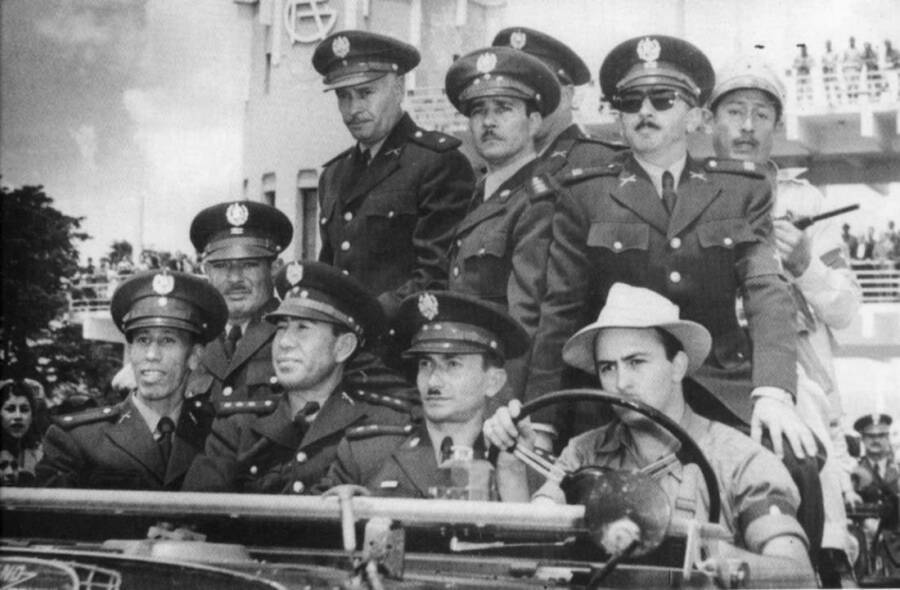
Guatemalan soldiers celebrate Carlos Castillo Armas' entry into power in Guatemala City, 1954.
The Guatemalan Coup of 1954: Unraveling Operation PBSUCCESS
In a dramatic 1954 turning point, the CIA orchestrated the overthrow of Guatemala's democratically elected government under Operation PBSUCCESS. This clandestine action illustrates the lengths to which the U.S. was willing to go to safeguard its interests, plunging the nation into decades of turmoil. Delve into a covert operation that set a harrowing precedent for American foreign interventions.
What Happened
It was a balmy day in the tropical capital of Guatemala City on June 27, 1954, but the political atmosphere was anything but warm. It was chilling, unstable, a landscape upended by international intrigue and internal distrust. That day marked the culmination of a covert operation executed from the shadows by the mightiest of world superpowers — the United States. Operation PBSUCCESS wasn't just a chapter in Guatemala's history; it was the keystone of a complex geopolitical chess game that held far-reaching consequences for the Latin American nation and the ethos of democracy.
The operation was conceived in the cold war rooms of Washington D.C., driven by an anxiety simmering beneath the facade of American diplomacy. The Cold War was at its zenith, a period when communism was the specter haunting capitalist nations. In November 1950, Jacobo Árbenz Guzmán, a major advocate for agrarian reform, was elected President of Guatemala. His ambitions to tackle land monopolies clashed violently with the interests of the United Fruit Company — an American business juggernaut with deep entrenchments in Guatemala's soil.

By 1953, the U.S. administration, led by President Dwight D. Eisenhower, had backed a CIA plan designed to destabilize and remove Árbenz from power. This plan was PBSUCCESS, a covert operation authorized with a mission to reinstate a government more amenable to U.S. interests. The operation had two linchpins: the psychological domain and a carefully crafted on-the-ground overthrow.
The CIA's scheming wasn't limited to tangible warfare. It was an insidious campaign operated through the ether, with the chilling broadcasts of the 'Voice of Liberation' stretching into Guatemala's radio waves. These narrations painted exaggerated, almost fantastical images of an incoming invasion, amidst roaring static-filled tales of armies bearing down on the capital. The intention was clear: to disorient, terrify, and cripple the morale of Árbenz's supporters, from high-ranking officials to the peasant farmers in the hinterlands.

But the manipulation reached further. On June 18, 1954, a coalition of mercenaries led by exiled military officer Carlos Castillo Armas crossed into Guatemala. The alleged strength and loyalty of these forces were as much a creation of CIA propaganda as reality, a force of approximately 480 men painted in the minds of the Guatemalan army as a threatening, massive coalition.
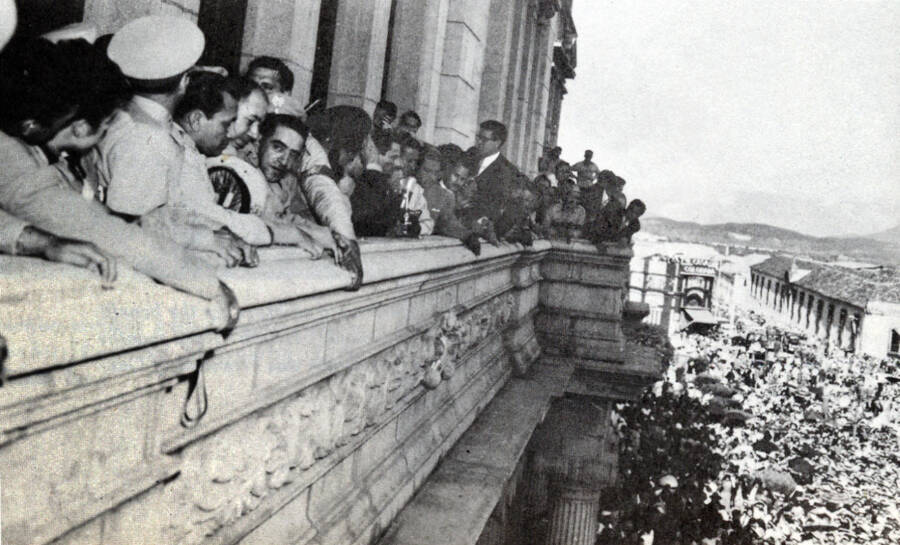
By the time Árbenz realized the precariousness of his situation — his army demoralized, his countrymen fractious — his control was irreversibly shattered. Pressured into submission, Árbenz resigned and sought asylum. On June 30, Castillo Armas triumphantly entered the streets of the capital, navigating between an enthusiastic reception and reluctance, as he assumed the role carved for him by American strategic imperatives. What followed was not the tranquil democratic revival the CIA had envisioned but a dark epoch etched in brutality and conflict.

Timeline of Key Events

1950 — Jacobo Árbenz Guzmán is elected President of Guatemala.
1951 — Árbenz introduces agrarian reforms benefiting impoverished farmers.
1952 — United Fruit Company expresses concerns over Árbenz's land policies.
1953 (August) — President Eisenhower authorizes CIA to initiate Operation PBSUCCESS.
1954 (March) — CIA's psychological warfare initiative begins in Guatemala.
1954 (May) — The 'Voice of Liberation' begins broadcasting expertly crafted propaganda.
1954 (June 18) — Carlos Castillo Armas leads an invasion force into Guatemala.
1954 (June 25) — Guatemalan military falters, partly due to psychological operations.
1954 (June 27) — Jacobo Árbenz resigns from the presidency, fleeing Guatemala.
1954 (June 30) — Castillo Armas enters Guatemala City, assuming power.
1954 (July) — Castillo Armas gains dictatorial control, suppressing opposition.
1955 — Reversal of Árbenz's agrarian reforms takes place.
1957 — Castillo Armas is assassinated, leading to political instability.
1960 — Onset of prolonged Guatemalan civil war.
1982 — Guatemala declares a state of siege amidst intensifying conflict.
1996 — Peace Accords are signed, concluding the civil war.
1999 — President Bill Clinton apologizes for U.S. involvement in the coup.
2003 — Declassification of CIA documents sheds new light on PBSUCCESS.
2023 — Renewed investigations reveal connections between CIA and business interests.
2026 — Witnesses come forward, broadening the understanding of the operation.
What Is Documented
CIA documentation reveals Operation PBSUCCESS as an undertaking designed with precision and stealth. Officially approved in August 1953, the operation's concept was presented in National Security Council planning as a necessary measure to curtail the perceived communist threat from the Árbenz regime. The budget set by the Allen Dulles-led CIA hovered around $2.7 million, allocated for methods that included psychological warfare and inducing political destabilization.
Declassified files from The National Security Archive delineate a force consisting of 480 men under Carlos Castillo Armas, each individual trained primarily in Honduras, supported materially and logistically by CIA hands. This strike force, however, depended less on its numbers than on the widespread dissemination of its supposed might and invincibility.
Integral to the operation was the feature of intimidation through disinformation: the so-called 'Voice of Liberation' aimed to sow uncertainty and fear by broadcasting fictional accounts of widespread defections and imminent large-scale military incursions. CIA station documents captured this element as essential for breaking the morale of both Árbenz loyalists and civilian supporters.
Communiqués within CIA internal dispatches underscore the urgency pushed by American corporate stakeholders. The United Fruit Company's concerns were repeated often, reflecting their influence over the operation’s execution. The depth of this corporate relationship is illustrated in unattributed cables and less-redacted accounts emerging in the later stages of document release.

Firsthand accounts by surviving members of Árbenz's administration, captured within congressional records of later hearings, provide additional, corroborating testimony to the transformative fear that this psychological onslaught created. These testimonies suggest that PBSUCCESS was as much about altering or controlling narratives as it was about the physical act of military confrontation.
What Has Been Alleged
A battery of allegations has emerged over the years related to the true motivations and methods behind Operation PBSUCCESS. Chief among these is the claim that the actual agenda behind the operation went beyond curtailing communism to serving as a model of economic imperialism cloaked in Cold War rhetoric. Noam Chomsky and other critics allege the impetus of corporate influence, specifically that of the United Fruit Company, as the engine driving U.S. intervention.
These claims are fortified by documented meetings between UFCO executives and U.S. policymakers, though hard evidence remains scant in terms of direct causation. This theoretical underpinning rests partly on Edgar E. Browmell's controversial research, suggesting that coercive suggestions from influential lobbyists aligned too seamlessly with policy shifts.
Another persistent claim hinges on the alleged assassination lists — an element aired in journalistic inquiries but lacking substantial proof. Proponents of this theory cite interviews with supposed CIA affiliates, painting PBSUCCESS as potentially a larger operation, including targeted eliminations. This remains contested, lacking tangible documentation or declassified acknowledgment directly linking sanctioned assassination to PBSUCCESS’s official goals.

Human rights groups persistently allege that the U.S. overlooked clear indicators of impending dictatorial governance in Guatemala. The nature of the Castillo Armas regime, characterized by tight authoritarian control and wide-ranging abuses recorded by Amnesty International and similar organizations, revealed an anticipated but supposedly ignored consequence. These allegations question whether potential warning signs of brutality were evident in early CIA reports but were ignored for strategic convenience.
What Remains Disputed
The origins of PBSUCCESS are shrouded in disputes, particularly over the portrayal of Árbenz's policies as directly communist. Documented U.S. assertions indicated a Soviet-backed plot, yet Árbenz himself declared his government was nationalist, striving for autonomy and reform against dependency on American corporations. Esteemed historians like Greg Grandin argue Árbenz’s policies were misrepresented to justify intervention.
While official U.S. records presented the coup's aftermath as peaceful and stabilizing, independent analyses counter this, painting Castillo Armas's regime as inherently unstable from inception. Scholarly works and NGO reports illustrate that PBSUCCESS ignited decades of upheaval rather than delivering intended regional stability.
Further contention surrounds the CIA’s recognition of Castillo Armas’s authoritarian tendencies before the coup. U.S. internal documents lack any expressed foresight or regret, yet dissenting analysts argue the agency underestimated the repercussions of placing a puppet dictator in power. The complexity of this dynamic is debated extensively in academic circles and diplomatic reviews.

Finally, the scale of U.S. direct involvement, especially in terms of logistics and military presence, has been minimized in some government accounts. Guatemalan narratives often highlight a broader imprint left by American operatives, which contrasts with the pared-down version depicted in some declassified files. This discrepancy feeds into deeper debates about transparency and narrative control from military and historical perspectives.
What Was Later Confirmed
The slow unspooling of truths around Operation PBSUCCESS came years after the ink dried on history's first drafts. Initial denials downplaying direct U.S. involvement were overturned as declassified CIA cables and directorial briefings emerged, primarily through the efforts of historians and inquisitive journalists in the 1990s and early 2000s. In particular, executive summaries from the CIA, once redacted, began providing confirmation of the direct orchestration and financial backing for the Guatemalan coup.
Among the notable revelations were those related to the overt operations of psychological manipulation. Initial United States cables denied their extent but acknowledged their influence only after documents surfaced showing the calculated deployment of radio broadcasts designed to sow discontent and fear within Guatemala. Transmitted broadcasts during the peak of the coup provided stark evidence of the operational scope.
A significant milestone in re-assessment came in 1999 when President Clinton's public apology to Latin America signaled a shift in official stance, renouncing past covert operations. This corresponded with increasing academic attention, leading to the emergence of books and articles that pierced the shroud of obfuscation surrounding plans, outcomes, and secondary U.S. interests tied to corporate influences.

The uncomfortable relationship between the Operation and American business interests also received validation when internal correspondences confirmed dialogues around safeguarding company positions, particularly regarding banana exports. It unraveled the sanitized narrative long upheld in geopolitical forums, aligning closely with allegations that initially seemed too radical to entertain.
Common Myths & Exaggerations
Misinformation often blurs history, and Operation PBSUCCESS is no exception. One particularly persistent myth is that the operation consisted purely of military maneuvers, whereas psychological operations played a parallel, if not more significant, role in achieving the destabilization of the Árbenz government. This myth often fails to account for the sophisticated network of propaganda.
There's also the idea that Castillo Armas was a universally welcomed liberator. Historical records disprove this myth, highlighting significant opposition and factions within Guatemala that opposed the new regime. The progression of his rule into an authoritarian one illustrates a lack of consensus and foreshadows the tumultuous decades that followed.
Another misunderstanding is the characterization of PBSUCCESS as a clean sweep against communism. While communism was highlighted as the primary threat, deeper investigation shows that the protection of American corporate interests equally drove the urgency of intervention. It was more an act of economic safeguarding than an ideological crusade.
Additionally, the myth of rapid post-coup stabilization has been widely propagated. Historical documentation and survivor accounts show prolonged unrest and societal disintegration, contradicting the narrative of swift resolution often presented in earlier U.S. documents.
Why It Matters
Deciphering the intricacies of Operation PBSUCCESS sheds light on the continuing repercussions of foreign interventions by powerful nations. As a blueprint for subsequent coups, it set a disconcerting precedent, framing covert regime change under the guise of anti-communism, a rationale often echoed loudly in American foreign policies even today.
This coup prioritized economic interests over democratic principles, illustrating the willingness of countries to manipulate sovereign politics for corporate gain. It’s a critical case study, offering a lens into how past interventions have shaped ongoing geopolitical landscapes, particularly in Latin America, where U.S. policies continue to provoke dialogue and dissent.
Recognizing the impact of Operation PBSUCCESS sees us beyond mere historical curiosity. The operation isn't just a closed chapter; the structural violence it initiated provided a foundation for recurring civil conflicts that are catalysts for current human rights challenges within Guatemala. Identifying causality within these historical tapestries informs diplomatic approaches and bilateral engagements.
Moreover, PBSUCCESS's narrative challenges individuals and institutions today to consider the ethical dimensions of interventionism. Its legacy invites reflection on the precarious balance between national security and moral compass — considerations vitally relevant in today's interconnected world — where the echoes of past errors can provide cautionary tales for future actions.
Connections to Other Archive Entries
Operation PBSUCCESS is part of a broader pattern of U.S. interventions during the Cold War, echoing the 1953 coup in Iran and later actions such as the Bay of Pigs invasion in Cuba. The tactics — psychological manipulation, covert funding, reliance on propaganda — reveal consistent CIA methodologies applied across varied geopolitical theaters.
Such interventions also draw parallels with the NSC-68 framework, a strategic document that delineated the U.S. policy of containing communism globally at any price. The resonate threads of this policy are visible today in regions such as the Middle East, where American-led regime changes continue, prompted by definitions of threat that reshape political landscapes under banners of democracy and freedom.
Additionally, connecting PBSUCCESS to other counter-communist actions allows us to trace how intelligence and military strategies evolved, affecting global relations, especially in hemispheric alliances. These lessons inform current statecraft and underscore the necessity to critically approach international engagements influenced by historical precedents.
Sources & References
PRIMARY SOURCES
SECONDARY SOURCES
The Hidden History Archive is part of The Beacon Wire entertainment and informational platform. All archive articles are based on public sources, declassified documents, court records, and reputable journalism. Facts are clearly separated from allegations, disputed claims, and unsupported speculation. Nothing in this archive should be interpreted as legal advice or as incitement to harm. Readers are encouraged to consult primary sources directly.
We use cookies to improve your experience and analyze site usage. See our Cookie Policy for details.