
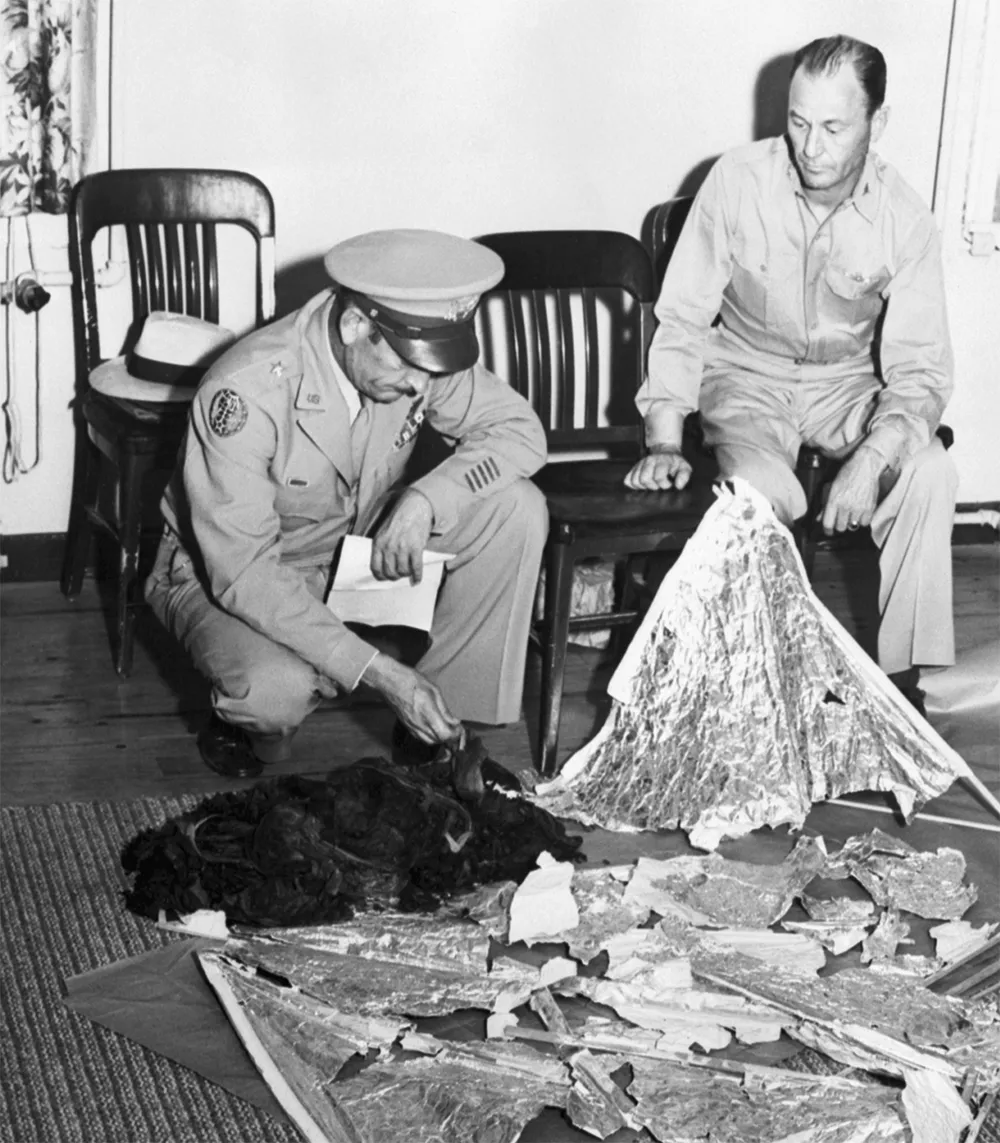
Debris from the alleged Roswell crash is displayed by military personnel on July 8, 1947.
Roswell 1947: The UFO Cover-Up That Won’t Disappear
In July 1947, an object crashed near Roswell, New Mexico, lighting a firestorm of UFO conspiracy theories. Despite official reports claiming the debris was from a weather balloon, suspicions of a cover-up persist. We investigate the mysterious events, government responses, and enduring impact of the incident.
What Happened
On a searing July day in 1947, the afternoon sun beat down over the arid plains of New Mexico, unknowingly setting the stage for one of the most enigmatic events in American history. A rancher named W.W. "Mac" Brazel stumbled upon something altogether out of the ordinary in a field near Roswell—a sprawling scatter of bizarre metallic debris, oddly lightweight, with otherworldly symbols etched upon its surface.
Baffled by the unidentifiable wreckage, Brazel sought counsel from Sheriff George Wilcox, who, recognizing the peculiar nature of the find, deemed it essential to contact military authorities. Enter Major Jesse Marcel, an intelligence officer at the Roswell Army Air Field. He arrived on the scene with a directive to examine, gather, and identify the mysterious materials. What Marcel found only fueled speculation: fragments of an uncanny metal, impervious to damage, and bearing inscriptions like hieroglyphs. His examination conjured images of spacecraft and science fiction's fantastical creations.

On July 8, the Roswell Daily Record printed a headline that would reverberate through conspiracy circles for decades: “RAAF Captures Flying Saucer on Ranch in Roswell Region.” The Army's daring press release heralded the capture of an unidentified flying object, a narrative new to the public consciousness in an era burgeoning with flying saucer sightings.
Yet no sooner had these revelations been proclaimed than they were swiftly retracted. As if scripted by providence, the military backtracked, presenting a starkly different scenario—what was initially thought to be extraterrestrial was, in truth, a prosaic weather balloon. Or was it? This rapid shift plunged the entire affair into a quagmire of obfuscation and subterfuge that birthed a legacy of distrust.

Internal military memos circulated, commanding secrecy and compliance. The debris was clandestinely transported to strategic bases for analysis, with eyewitnesses later alleging that they faced pressuring silence, leaving an incredulous public grappling with the glaring discrepancy.
Despite the government's reassurances, the community's imagination ignited. Roswell transformed from a sleepy town into the epicenter of a burgeoning subculture dedicated to the pursuit and belief in the existence of extraterrestrial life. The incident's allure endures, a compelling testament to humanity's tireless quest to explore that which lies beyond our earthly bound.

Timeline of Key Events

1947 — June: The United States begins recording an uptick in UFO sightings.
1947 — June 14: W.W. "Mac" Brazel observes unusual debris near Roswell, but does not report it immediately.
1947 — July 2: A severe thunderstorm coincides with reports of an explosion in the Roswell area.
1947 — July 5: Brazel revisits the debris field, noting its peculiar characteristics.
1947 — July 6: Brazel contacts Sheriff George Wilcox about the strange debris.
1947 — July 7: Major Jesse Marcel is instructed to investigate the discovered debris.
1947 — July 8: Roswell Army Air Field distributes a bulletin claiming the capture of a flying saucer.
1947 — July 8: The Roswell Daily Record publishes its famous headline about the flying disc.
1947 — July 9: U.S. military retracts the initial statement, describing the debris as remnants of a weather balloon from Project Mogul.
1947 — July 10: Said debris is moved to Wright-Patterson Air Force Base for further examination.
1950 — Jesse Marcel begins sharing personal accounts contradicting official narratives.
1994 — General Accounting Office initiates an investigation into previously classified Roswell documents.
1995 — U.S. Air Force issues the "The Roswell Report: Fact vs. Fiction in the New Mexico Desert."
1997 — Roswell celebrates its 50th anniversary, renewing public and media interest.
2002 — Publications claim UFO bodies were recovered, fueling public controversy.
2011 — Smithsonian experts debunk some myths while recognizing Roswell's cultural impact.
2013 — CIA reveals declassified documents demonstrating ongoing UFO investigations.
2017 — 70th anniversary prompts renewed discussions on extraterrestrial phenomena.
2020 — Several declassified military documents fuel public interest in UFOs.
2023 — Hearings in U.S. Congress reignite inquiries into unidentified aerial phenomena.
2025 — Modern research into UFO sightings lends credibility to historical accounts.
2026 — The Roswell incident remains a subject of intrigue, public discussion, and ongoing examination.
What Is Documented
The Roswell incident officially began on the hot summer day of July 8, 1947, when the Roswell Army Air Field issued a press release announcing the recovery of a "flying disc" on a local rancher's land. This announcement, however hasty, became an instant headline sensation within hours. Notable figures emerged, such as Major Jesse Marcel, who personally handled and examined the unexplained debris, fueling speculation with his initial impressions of its extraordinary properties. This sequence of events quickly captured national interest.
Facts, obscured by layers of military secrecy, began to crystallize with the deeper investigation. Significantly, the retraction of the initial press statement centered on a revised claim: the crashed debris originated from a military experiment known as Project Mogul. This top-secret operation, involving the launch of high-altitude balloons to detect Soviet nuclear tests' acoustic signatures, offered a non-alien explanation for the materials found at Roswell.
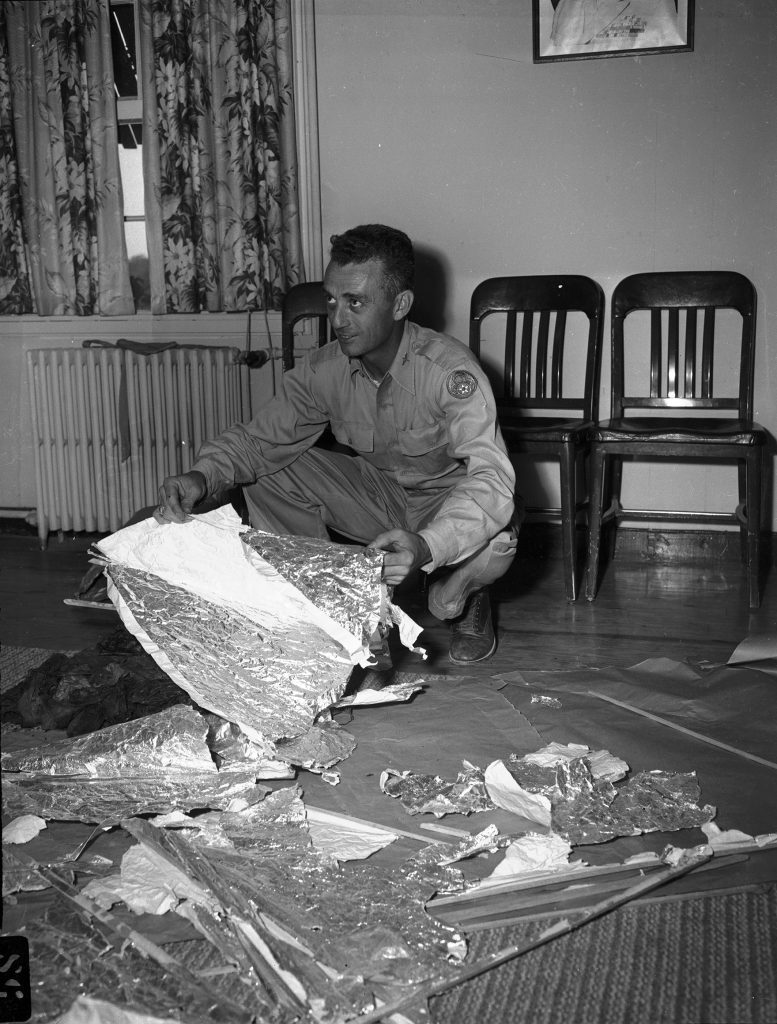
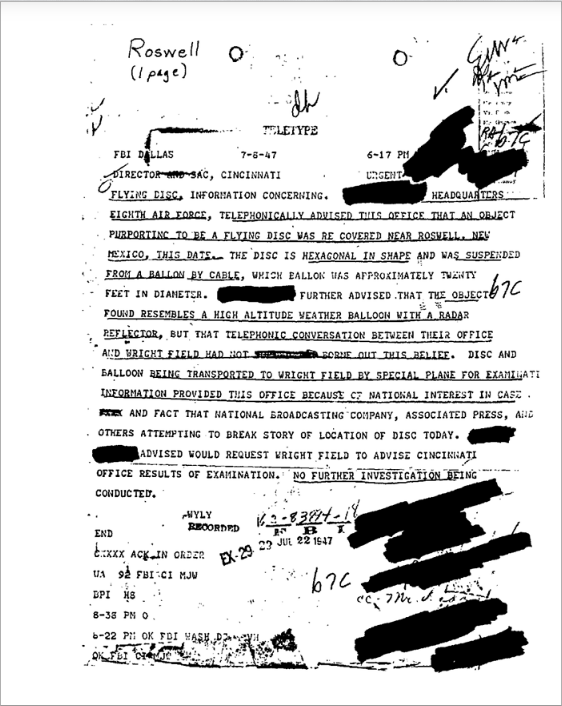
Official documents—declassified roughly half a century later, particularly those from U.S. Air Force reports in 1994 and 1995—corroborated this version of events, presenting the weather balloon narrative as plausible yet initiated under stringent Cold War secrecy protocols. These releases also aimed to address civilian concerns of misinformation while providing a coherent account of the events.
Adding credibility to the mundane explanation, additional declassified records between 2013 and 2020 from the CIA and U.S. military further contextualized the Roswell event within a broader framework of UFO investigations. However, despite such disclosures, many felt that sightings and witness accounts were not conclusively explained by the sanctioned narrative. Indeed, declassified documents revealed a persistent undercurrent of military scrutiny regarding unidentified aerial phenomena, although solid proof of extraterrestrial craft at Roswell remained elusive.
What Has Been Alleged
Allegations surrounding Roswell began swirling with the stubbornness of desert sandstorms. Enthusiastic UFOlogists and independent researchers like Stanton T. Friedman asserted that what transpired in Roswell was far from an ordinary crash. Despite official denials, Friedman's book "Crash at Corona" alleged a high-stakes cover-up, claiming military personnel retrieved alien bodies from the site, hidden under orders from federal overseers.
Central to these allegations is the role of former mortician Glenn Dennis. Dennis recounted that around the time of the incident, he received odd requests at the nearby military base: child-sized coffins and queries about body preservation. Dennis, aligning with conspiracy proponents, claimed he witnessed strange anatomical forms while visiting the base hospital, a narrative echoed by others who later stepped forward.
Further incriminating, Walter Haut, the then public information officer, confessed in a detailed affidavit released posthumously. Haut claimed an intimate awareness of a cover-up, insisting he saw evidence of extraterrestrial craft and creatures discussed by military officials. His confession, although lacking direct corroboration, breathed life into decades of rumor and heightened suspicions of governmental deceit.
Despite such enthralling stories, these assertions primarily rely on anecdotal testament and retrospective confessions, making verification challenging. The absence of physical proof or documented corroboration keeps many of these allegations within the realm of compelling myth rather than substantiated truth. Nonetheless, as detailed in the book "UFOs: Generals, Pilots and Government Officials Go on the Record," the shadow of a cover-up looms, as insiders persist with claims of government silencing due to an unimaginable scale of concealment.
What Remains Disputed
Roswell is a battlefield of contentions, pitting official narratives against fervent believers in extraterrestrial visitation. A core point of contention lies with the military's assertion that the material recovered was merely balloon debris. Witnesses like Jesse Marcel describe indestructible materials contrary to any known earthly constructs, in stark opposition to these official accounts.
Exploring the evidence—or lack thereof—divides lines further. The military claims are supported by formal investigations and documentation, especially regarding Project Mogul, suggesting that strategic secrecy was the motivating force behind this confusion. However, independent researchers maintain that the swift and forceful denials suggest a more complex reality: possibly one involving extraterrestrial craft.
Compounded by cultural portrayals and media amplification, Roswell's narrative evolved into a symbol for both government conspiracy and a highlight of customary overreach. The region's transformation into a mecca for UFO tourism sometimes tips the balance towards commercialization rather than factual introspection, stirring skepticism toward motives within those engaging in ufological pursuits.
What Was Later Confirmed
Not all initial denials about the Roswell incident persisted unchallenged. Over time, certain facets became more transparent, proving that military strategists and bureaucrats withheld critical information. Project Mogul’s eventual declassification in the mid-1990s demonstrated the concerted effort to safeguard national interest, particularly against Cold War adversaries. These revelations lent credence to official justifications that the debris was of this secretive yet Earthly origin.
A broader revelation came with the 2013 declassification wave that unfolded before the public eye, unveiling CIA oversight and Air Force initiatives delving into UFO phenomena. The sustained governmental interest in unexplained aerial activities bolstered narratives of a guarded agency agenda and chipped away at categorical denials of any concealed investigations.
These progressive admissions highlighted an environment of controlled information flow, ensuring military technologies and covert operations remained shielded from public probe, effectively sowing seeds of public intrigue regarding what the government deems silence-worthy.

Common Myths & Exaggerations
The Roswell incident is not without its multitude of myths, propagated through a mixture of misunderstandings, exaggerations, and fiction dressed as fact. One prevalent myth asserted unfoundedly assumes that an intact alien craft, along with extraterrestrial bodies, were retrieved—a tale vivid in detail yet unsupported by empirical evidence or photographic proof.
Another extrapolated exaggeration posits that Roswell marked humanity’s inaugural contact with alien civilizations—an event heralded as the starting point of ongoing extraterrestrial liaisons. Yet, records show chronology with no marked irregularities that suspend over existing military encounters, debunking the claim of its purported preeminence.
Misrepresentations extend to insinuations that subsequent UFO encounters globally are directly tethered to Roswell’s theoretical alien technologies, directing blanket assumptions across isolated and diverse events. The mythos, often embellished by cultural artifacts such as films and literature, have forged persistent falsehoods embraced by an ever-hopeful collective consciousness.
Why It Matters
The Roswell incident has undeniably secured its niche in 20th-century history, providing profound lessons on the intersection of governmental secrecy, public inquiry, and the pursuit of truth. Situated within the broader narrative of Cold War tensions, Roswell reflects strategic priorities where concealment of sensitive operations was justified under the defense shield, modeling modern secrecy prototypes.
The ramifications extend into modernity, facilitating a systemic mistrust in governmental transparency as constituents question the depth of what remains undisclosed in contemporary military programs. Such dissections affirm crucial dialogues on civil liberties, the right to information, and delineations of national security narratives crafted and maintained post-Roswell.
Moreover, the incident lays the groundwork for robust interdisciplinary explorations—from aerospace to metaphysics—enabling an embrace of speculative academia that thrives on societal curiosity. Popular and persistent, Roswell enthuses a multitude of cultural incarnations, infiltrating global storytelling and entertainment, reflecting a deeply ingrained communal desire to unravel and understand the unknown. The endurance of Roswell continues to be emblematic of an era—as much a puzzle of historical secrecy as it is a springboard for expansive thought and exploration.
Connections to Other Archive Entries
Roswell sits at the apex of a tangled web of historical secrecy, connecting to major national projects like the Manhattan Project, sharing the same veil of confidentiality, urgency, and consequential shadows stretching post-war geopolitical dynamics. This cloak extended significantly during the Cold War, as Project Mogul paralleled classified military endeavors operating beneath the public's suspicion horizons.
The infamous Project Blue Book, from 1952 to 1969, serves as another touchpoint in historical aviation mystery investigations, reflecting continuation of government methodologies initially encountered during the Roswell response. Such linkages offer a continuum of governmental approaches to handling unexplained phenomena, underscoring lessons absorbed from earlier endeavors.
More recent analogs, such as the Kecksburg UFO incident, echo Roswell’s enduring essence: a finely interwoven narrative of disbelief and skepticism patterned through interactions with potential extraterrestrial experiences, bridging historical pastures with fervent inquiries into unexplored possibilities.
Sources & References
PRIMARY SOURCES
SECONDARY SOURCES
The Hidden History Archive is part of The Beacon Wire entertainment and informational platform. All archive articles are based on public sources, declassified documents, court records, and reputable journalism. Facts are clearly separated from allegations, disputed claims, and unsupported speculation. Nothing in this archive should be interpreted as legal advice or as incitement to harm. Readers are encouraged to consult primary sources directly.
We use cookies to improve your experience and analyze site usage. See our Cookie Policy for details.