
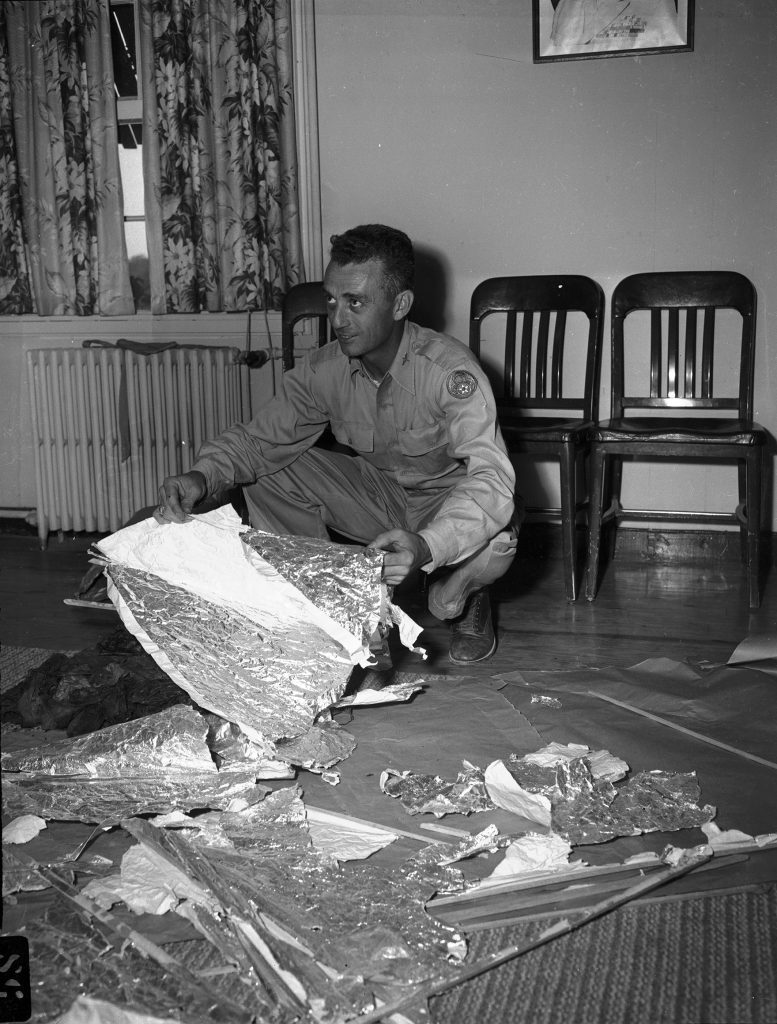
1947 photograph showing Major Jesse Marcel with Roswell crash debris remnants, sparking new debates.
Roswell 1947: Unveiling the Government Cover-up
In the summer of 1947, the desert near Roswell, New Mexico, became ground zero for a saga of mystery and governmental secrecy that has captured imaginations for nearly eight decades. With changing official stories and evolving witness testimonies, the Roswell Incident is a window into the psyche of post-war America and its ongoing quest for extraterrestrial truth.
What Happened
The summer of 1947 in Roswell, New Mexico, buzzed with the extraordinary. It began as a typical season in this quiet town nestled in the New Mexican desert, until intrigue descended rapidly from above. The Roswell Incident has since become an emblem of modern alien folklore and a case study in government secrecy.
It began with rancher Mack Brazel, who stumbled upon a scattering of bizarre debris in a remote field. Tantalizing and unidentifiable, these materials included strange metal strips, thin, tinfoil-like sheets, and a peculiar rubber-like substance spread across his land. Bewildered by the find, Brazel took some samples to Roswell's sheriff, who then contacted authorities at Roswell Army Air Field.

Major Jesse Marcel, the base's intelligence officer, arrived at the site with urgency. Marcel collected bits and pieces of the enigmatic debris. He was reportedly taken aback; the materials didn't resemble any known aircraft or military craft. Additionally, some fragments bore unusual symbols, indicating something out of the ordinary.
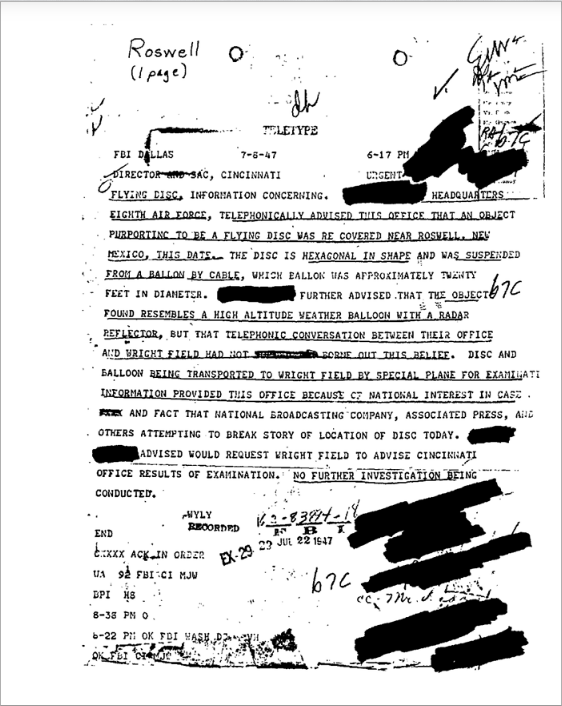
As news of the discovery reached national broadcasts, the Roswell Army Air Field announced in a press release on July 8, 1947, that a 'flying disc' had been recovered. In a time when the term 'flying saucer' was just entering the popular lexicon, this proclamation electrified the public. However, a swift and confusing U-turn followed—the very next day, officials retracted the statement, asserting the debris was part of a misunderstood weather balloon.

Rumors and tension escalated as military personnel swarmed the site. The debris was whisked away, reportedly to higher-level military facilities in Fort Worth, Texas. Here, press photographs were displayed next to a mundane weather balloon—an exhibit many believed was staged, given the discrepancy between the claimed mundane materials and Marcel's statement of finding unusual, almost supernatural components.
Decades have passed, yet this enigmatic event remains unsolved. Initial military explanations were challenged by interviews and emerging technologies which hinted at alternative truths. The incident has since inspired a wealth of books, documentaries, and conspiracies, continuously challenging the official narrative. This unyielding public fascination underscores Roswell's impact on America's trust in government transparency and its persistent quest for cosmic truths.

Timeline of Key Events

1947 — Rancher Mack Brazel finds strange debris on his land near Roswell.
1947 — July 8: Roswell Army Air Field announces discovery of a 'flying disc.'
1947 — July 9: Air Force retracts the statement, labels it weather balloon debris.
1947 — Debris is transported to Fort Worth Army Air Field for evaluation.
1950 — Roswell story and UFO sightings fuel public curiosity and media sensationalism.
1952 — Project BLUE BOOK is launched to investigate UFO sightings.
1956 — Jesse Marcel retires and begins speaking publicly about the event.
1969 — Project BLUE BOOK is terminated, declaring most UFO sightings explainable.
1978 — Marcel gives an interview, reigniting interest and speculation.
1980 — 'The Roswell Incident' by Berlitz and Moore brings the story to mainstream.
1994 — U.S. Air Force releases report identifying the debris as Project Mogul equipment.
1997 — Air Force releases 'Roswell: Case Closed,' aiming to debunk alien theories.
2000 — Glenn Dennis claims his involvement with alien bodies after the incident.
2007 — Popular culture continuously churns out references to Roswell incident.
2012 — Declassification of CIA documents reveals cold war-era surveillance programs.
2013 — Renewed congressional interest causes partial declassification of documents.
2017 — Pentagon releases UFO footage, kindling public interest once again.
2020 — Technological advances lead to re-analysis of surviving Roswell artifacts.
2025 — New witnesses step forward with testimonies adding to the mystery.
2026 — Roswell remains a cornerstone of UFO and conspiracy culture debates.
What Is Documented
The Roswell story is interwoven with a tapestry of documented events, many of which have been declassified over several decades. The initial Roswell Army Air Field press release in July 1947 clearly stated that they had recovered a 'flying disc.' This moment was historically significant as it marked a public acknowledgment by the government of an unidentified flying object recovery, albeit fleetingly.
By July 9, a dramatic shift occurred when the military recontextualized the story. The debris was now identified as remnants of a weather balloon. This rapid pivot was supported by the presentation of mundane objects to the press, though skepticism and allegations of a cover-up proliferated.

Years later, a substantial revelation arose with the declassification of documents relating to Project Mogul. According to the 1994 Air Force Roswell Report, the wreckage was indeed part of this top-secret program. Project Mogul sought to detect Soviet nuclear tests via high-altitude balloons carrying instruments to pick up distant sound waves. This component of the Cold War intelligence operations was a program even U.S. service members at the base possibly knew little about.
The 1997 report, 'Roswell: Case Closed,' aimed to quell extraterrestrial allegations, by again attributing confusing initial reports to Cold War secrecy. However, these attempts did little to dampen the fires of public speculation.
Declassified CIA documents from the post-World War II era, focused on unidentified aerial phenomena, revealed a profound military interest in UFOs. While none specifically confirmed alien technology, they documented government efforts to catalog UFO sightings comprehensively. This interest underscored the intelligence community's contemplation of aerial anomalies, feeding into broader public narratives of governmental secrecy.
What Has Been Alleged
Many elements of the Roswell narrative lean heavily on allegations and personal testimonies, unsupported by conclusive evidence. One prominent figure, Major Jesse Marcel, consistently claimed that the recovered materials were extraordinary—exhibiting qualities not associated with known military technology. Marcel's accounts, especially his late-life interviews in the late 1970s, fueled speculation of extraterrestrial origins.
Further allegations emerged from Glenn Dennis, a local mortician, who claimed to have been involved when the military requested child-sized coffins shortly after the crash. Dennis suggested that alien bodies were found at the crash site, but these allegations have been criticized for inconsistencies across retellings, as well as gaps in corroborating evidence.
Researcher Stanton Friedman further popularized claims of a systematic governmental effort to obscure the truth about Roswell. According to him, evidence and witnesses were manipulated or silenced under direct pressure from the military. Friedman's investigative narrative implies a far-reaching coverup, positing that the crash site held advanced technology.
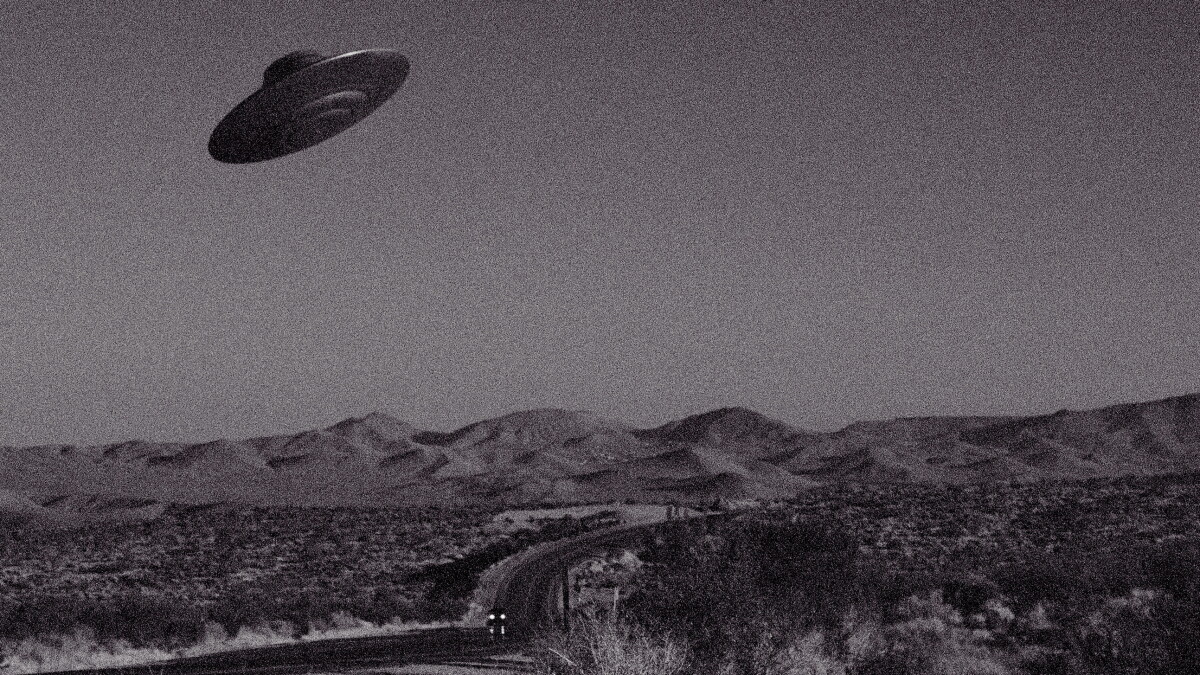
Despite their dramatic elements, these allegations remain largely speculative. Individuals present at Roswell or their descendants have made claims—but many of them contradict each other, thus sustaining the mystery without delivering any irrefutable proof of alien contact.
What Remains Disputed
The dichotomy between official explanations and independent researchers' claims keeps the Roswell incident deeply disputed. On one side, the U.S. Air Force has maintained a consistent line—attributing the crash to Project Mogul. They assert that the confusion stemmed from the secretive nature of Cold War operations coupled with the era's nascent media influence.
In opposition, Ufologists and skeptics criticize governmental narratives as inadequate, citing inconsistencies. Eyewitnesses accounts often misaligned with military reports, suggesting discrepancies in what was recovered and how events transpired.
Disputed elements also rest heavily on physical descriptions of the debris. Eyewitnesses, such as Major Marcel, recalled materials that reportedly outmatched contemporary human technology in their lightweight yet durable nature. These descriptions are contested by atmospheric physicists and materials experts, challenging their plausibility within the period's scientific understanding.
Thus, this chain of conflict persists with pro-truth activists advocating for complete transparency and declassification of all existing Roswell-related documents, continuously fueling the debates.
What Was Later Confirmed
Later confirmations regarding the Roswell incident primarily revolve around the existence and objectives of Project Mogul. For decades, the Air Force denied any significant activity outside of typical military exercises. However, the 1994 Air Force report acknowledged the link to this clandestine surveillance program, aimed at early detection of Soviet nuclear activities during the Cold War. This admission brought a measure of closure to some aspects of the strictly terrestrial explanations.
Another critical confirmation, surrounding declassified documents, revealed the government's broader interest in UFO phenomena during the late 20th century. While none clarified extraterrestrial activity, these documents showcased meticulous cataloging of unidentified objects and events that piqued military interest.
These revelations confirmed military and intelligence services' deep involvement in aerial investigation mechanisms but cautiously navigated clarifying any extraterrestrial involvement. By doing so, they left broad UFO conspiracy theories intact, especially those related to Roswell, allowing them to adapt and proliferate amidst the national consciousness.

Common Myths & Exaggerations
The Roswell incident has spawned numerous myths, intersecting with cultural and media interpretations that have often steered away from factual grounding. Notably, the concept of alien bodies being recovered from the crash site is among the most pervasive yet unsupported myths. No credible evidence has ever confirmed the presence of extraterrestrial beings; only speculative stories perpetuated these claims.
Another prevalent myth suggests the U.S. government executed a complete media blackout to suppress any real details about the incident. In reality, there was media coverage, though confused and varied, as the story evolved rapidly over those few pivotal days.
The narrative that Roswell represents an isolated incident in a chronological vacuum is another falsehood. Instead, it serves as one facet of broader UFO speculation that permeated the 20th century, dovetailing with other investigations like Project BLUE BOOK and the Washington D.C. UFO flap of 1952.
Lastly, exaggerations involving advanced alien technology wielded by secret government factions illustrate common themes in the Roswell lore's evolution. While captivating, these elements flourish more in fiction than substantiated historical analysis.
Why It Matters
Roswell's continued relevance in public discourse extends far beyond simple curiosity about UFOs. The 1947 incident highlights tensions in governmental transparency, igniting debates on secrecy's permissible boundaries in a democracy, especially concerning national security and the public's right to know.
The handling of Roswell and subsequent Air Force reports established early templates for managing unidentified aerial phenomena, setting significant precedents for future governmental policies on extraterrestrial research and disclosure. It also indirectly inspired major legislative oversight, such as the Freedom of Information Act, empowering citizen demands for transparency from all branches of government.
Culturally, Roswell has been indelibly imprinted on American and global consciousness. It spearheaded a massive cultural movement intertwining UFOs with entertainment, science, and strategic military concerns. Moreover, as governments worldwide progress slowly toward disclosure on unexplained aerial phenomena, Roswell remains a litmus test for measuring official transparency and efficacy.
In today’s age of digital information, the Roswell incident serves as a critical reminder of how secrecy, mistrust, and lack of clarity can propel conspiracy narratives and affect societal trust in institutional authority. It continues to configure contemporary conversations about the balance between state secrets and the public's informational sovereignty.
Connections to Other Archive Entries
The Roswell Incident stands as an influential hallmark in a broader tapestry of mid-20th century governmental secrecy and intelligence operations within the Cold War's shadow. It intersects with pivotal UFO investigations like Project BLUE BOOK, where similar scrutiny and public fascination paralleled Roswell's enduring narrative. This framework laid groundwork for widespread public intrigue and skepticism about governmental conduct around UFO phenomena.
Subsequent noteworthy events—such as the Washington D.C. UFO sightings of 1952—dovetailed with Roswell, reinforcing intense speculation about governances relational to unexplained aerial phenomena.
Furthermore, Roswell resonates with modern issues like the Snowden revelations and contemporary privacy debates, echoing timeless themes wherein governments grapple with transparency against the backdrop of national security. These historical linkages attest to Roswell's ongoing legacy as a central node in discussions about governmental accountability.
Sources & References
PRIMARY SOURCES
SECONDARY SOURCES
The Hidden History Archive is part of The Beacon Wire entertainment and informational platform. All archive articles are based on public sources, declassified documents, court records, and reputable journalism. Facts are clearly separated from allegations, disputed claims, and unsupported speculation. Nothing in this archive should be interpreted as legal advice or as incitement to harm. Readers are encouraged to consult primary sources directly.
We use cookies to improve your experience and analyze site usage. See our Cookie Policy for details.