
The Roswell Daily Record headline from July 8, 1947, announcing the discovery of a 'flying disc.'
Roswell 1947: Unraveling the Infamous UFO Incident and Its Legacy
In the scorching summer of 1947, an inexplicable event shook Roswell, New Mexico. The alleged UFO crash and consequential military coverup ignited global fascination. Delve into the unraveling mystery and its lasting impact.
What Happened
The summer of 1947 was like no other for the small community of Roswell, New Mexico. The town, nestled in the arid desert, was about to become the epicenter of an enigma that would haunt history for decades. On July 5, 1947, rancher W.W. 'Mac' Brazel stumbled upon a bizarre expanse of debris while working on the Foster Ranch. Strewn across the sands were fragments and materials unlike anything he had previously encountered, sparking curiosity and bewilderment.
Brazel collected some of the mysterious debris and headed to the local sheriff in Roswell. His report reached Major Jesse Marcel, the Intelligence Officer at the Roswell Army Air Field (RAAF). Marcel, after visiting Brazel's ranch, was equally intrigued by the metallic fragments and the peculiar inscriptions on their surfaces. He suspected that this was not an ordinary crash site.

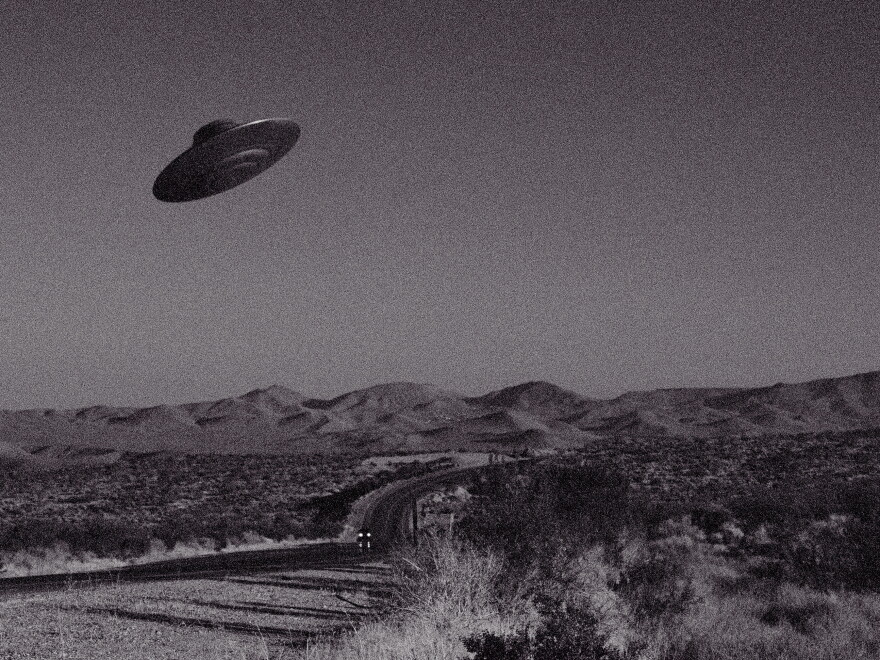
On July 8, the RAAF made a press release that would shake the foundations of modern conspiracy theories: the army had recovered a 'flying disc.' Mainstream media erupted with fascination and fear, pondering what this revelation could mean. The public was in thrall, imagining visitations from worlds beyond, and the atmosphere buzzed with the fantastical possibilities.
But the excitement was short-lived. Within hours, the narrative shifted. General Roger Ramey, commander of the Eighth Air Force in Fort Worth, Texas, convened a press conference with photographs depicting Marcel and the alleged UFO debris. This time, the story presented was mundane: the 'disc' was nothing but a high-altitude weather balloon.

The media's feverish interest cooled, but public suspicion simmered under the surface. Many found the retraction puzzling and incomplete. The debris was shipped to Wright Field in Dayton, Ohio, for further examination—a fact corroborated by several senior officers. Oddly, the official records from that point seem to diverge, cloaking subsequent operations in secrecy.
Despite the military's efforts to stifle the story, the seeds of skepticism and distrust had taken root. Over the following decades, Roswell would become shorthand for government subterfuge, the incident forever entwined with theories of extraterrestrials and shadowy plots. The question remained, what truly crash-landed in the New Mexico desert in 1947? The world is still waiting for an answer.

Timeline of Key Events
1947 — Rancher W.W. 'Mac' Brazel discovers strange debris on his property near Roswell, New Mexico.
1947 — Jesse Marcel, an intelligence officer, investigates the debris and forwards it to his superiors.
1947 — The Roswell Army Air Field announces the recovery of a 'flying disc.'
1947 — Shortly after, the military retracts the claim, stating the debris is from a weather balloon.
1949 — Project Grudge is initiated, furthering investigative work on UFOs under the U.S. Air Force.
1951 — Project Grudge is replaced by Project Blue Book to study UFOs more comprehensively.
1978 — Jesse Marcel gives interviews claiming a military coverup of the Roswell crash.
1980 — Charles Berlitz and William L. Moore publish 'The Roswell Incident,' reigniting interest.
1994 — The U.S. Air Force releases a report attributing the Roswell debris to Project Mogul.
1995 — The GAO conducts a probe into the Roswell incident, affirming the Project Mogul explanation.
1995 — 'The Alien Autopsy: Fact or Fiction' airs, claiming imagery from Roswell, later debunked.
1997 — The Air Force releases a second report focusing on the allegations of recovered alien bodies.
2000 — A series of affidavit releases provide contradicting details about the Roswell incident.
2004 — The Sci-Fi Channel sponsors a dig at the Foster Ranch crash site.
2011 — The FBI Vault online site releases a memo, the Hottel memo, sparking new interest.
2013 — Declassified documents from Project Blue Book are made available to the public.
2017 — The 'Roswell: Mysteries Decoded' series investigates new angles on the incident.
2020 — The Pentagon declassifies UFO videos, rejuvenating public interest in UFO phenomena.
2023 — Public surveys reveal a resurgence in belief in and concern over the Roswell incident.
2026 — New documentaries analyze the enduring cultural impact of the Roswell narrative.
What Is Documented
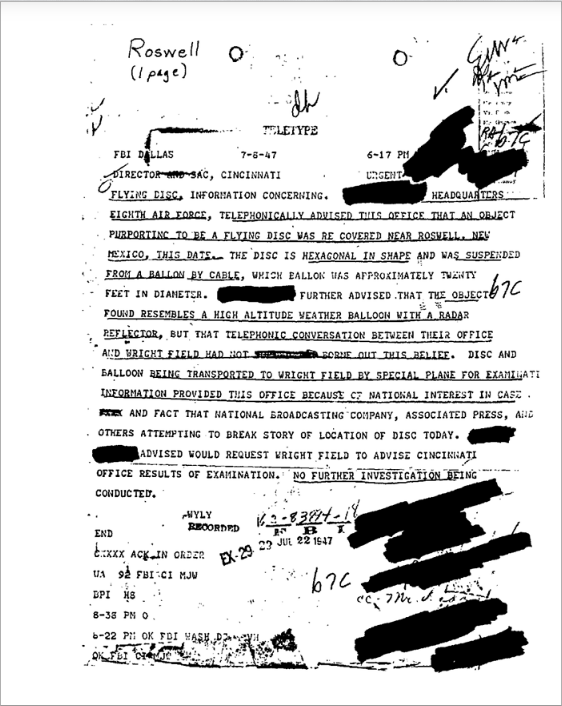
The Roswell incident stands as a dramatic exemplifier of American Cold War secrecy. Initially, the military issued a statement on July 8, 1947, which reported the recovery of a 'flying disc'—a phrase that captured the imaginations of millions. This message was disseminated across national press lines, giving credence to the possibility of an extraterrestrial visit.
Hours later, officials retracted the statement, giving rise to multiple cover story claims, most notably 'a found weather balloon.' This revised version centered around debris recovered under circumstances tied to military operations more so than extraterrestrial encounters.

The U.S. Air Force's release of Project Mogul documents in 1994 was a pivotal point. Project Mogul was a covert initiative designed to monitor Soviet nuclear tests using high-altitude balloons equipped with sensitive instruments. Crucially, it explained the debris' mysterious elements, like foil-lined balloons and balsa wood struts, supporting the military's revised account.
In the years following the Roswell event, numerous official documents emerged, both through declassifications and FOIA requests. The General Accounting Office (GAO) conducted an investigation in 1995, which concluded consistent Project Mogul involvement, thus allying with the Air Force's claims.
In 1997, another report by the Air Force focused on the alleged recovery of alien bodies, attributing these rumors to misidentifications of educational anthropomorphic dummies used in mid-to-late 20th-century military tests. This report, meant to thoroughly close the case, became the latest chapter in an ongoing saga of partial revelations.
Declassified FBI documents, such as the Hottel memo, further complicated the narrative by offering cryptic summaries of agent sightings—though often downplayed, these were interpreted by some as evidence of higher cover-ups. Despite these disclosures, the thirst for answers remains unquenched, with many continuing to seek truth amid layers of governmental clarification and obfuscation.
What Has Been Alleged
Allegations surrounding the Roswell incident are intricate and persisting, with key figures contributing to a narrative of conspiracy. Jesse Marcel, who collected debris at the site, alleged decades later that descriptions of the material were sanitized for the public. Marcel maintained until his death that the military distinctly miscommunicated the object's nature, pointing to extraterrestrial origins.
Expanding upon these allegations, Charles Berlitz and William L. Moore's book 'The Roswell Incident' posits claims backed by interviews with supposed eyewitnesses and insiders, including assertions that alien bodies were flown from the crash site to secretive military bases.
Other sources, purported whistleblowers, cited clandestine personnel movements and threats against locals to stifle dissonant accounts. Kevin D. Randle and Don Schmitt, notable UFO investigators, compiled affidavits from former servicemen recalling emergency protocols that significantly veiled the incident.
The 1995 'Alien Autopsy' footage stands as another focal point in Roswell lore. Although thoroughly discredited, its impact rekindled public interest and suspicion over hidden truths. Assertions were bolstered by ancillary stories from witnesses claiming direct observation of extraterrestrial beings amidst crashed wreckage at Roswell.
Adding to this tapestry are anonymous sourced tales of secret bunkers, underground facilities, and significant reverse-engineering of recovered material. Critics label these stories as speculative at best, lacking tangible evidence, yet they form a bedrock on which popular UFO theories thrive.
Despite an absence of concrete proof, allegations endure. Each claim builds on denials, reminding the public of how the absence of answers invites ceaseless inquiry. Until definitive, unfiltered disclosures emerge, the Roswell story will dangle as a historic marker of unresolved mystery.
What Remains Disputed
The Roswell enigma is characterized by a chasm between official accounts and alternative explanations. The U.S. military's dismissal of extraterrestrial involvement through Project Mogul has faced significant pushback from researchers. Alternative narratives insist upon alien involvement, citing whistleblower testimony and perceived inconsistencies in the military's evolving stories.
The conflicting statements and memory recollections of those involved fuel the dispute. Some claim government missteps and misdirection, alleging suppression of strange phenomena that remain unexplained within the limits of earthly logic. Conversely, government releases suggest simple miscommunication, compounded by post-incident media narratives.
Roswell's disputed nature is fueled by disparate layers: official reports that affirm mundane accidents and independent narratives fixing on extraterrestrial scenarios. These elements orchestrate an interpretive dance, wherein certainty remains elusive. Thus, Roswell's positioning in public consciousness oscillates between confirmed incident and skeptic's paradise.
In dissecting competing assertions, truth-seekers often find themselves mired in diverse interpretations. The interplay of verified records and enduring myths marks Roswell as an enduring battleground of belief and empirical skepticism.
What Was Later Confirmed
Initially cloaked in denials and misdirection, aspects of the Roswell incident emerged into clarity over subsequent decades. While clear consensus on the presence of extraterrestrials remains beyond reach, significant acknowledgments shifted original narratives.
The revelation of Project Mogul was a milestone in this journey. Once declassified, its scope and methodology explained the presence of peculiar materials at the crash site. Thus, long before headlines blared about UFOs, military-intelligence collaborations operated beneath public radar, with subtexts illuminating the intersection of national security and secrecy.
Despite the lingering mystery, declassified insights regarding coverups of Mogul's existence indicated substantive layers of truth, previously veiled under Cold War priorities. Acknowledging military obfuscation effectively confirmed a calculated veil over the incident. Such official admissions did little to convince diehard extraterrestrial enthusiasts but did validate suspicions of a coverup—in scope, if not in essence.

More recently, broader government acknowledgments of unexplained aerial phenomena suggest incremental transparency, leaving space for parts of the Roswell mystery to someday find resolution under public scrutiny.
Common Myths & Exaggerations
The Roswell incident is a cauldron of myth-making. Chief among the myths is the assertion that alien bodies were recovered from the crash. While convincingly relayed in tales rife with dramatic testimony, these claims lack verifiable evidence.
The notorious 'Alien Autopsy' film presented as documentation of extraterrestrial examination, was debunked as a hoax. Spectators were deceived by expertly fabricated footage, adding fuel to claims of governmental manipulation and mystery.
Myths surrounding Roswell have also leaned on supposed technological breakthroughs attributed to reverse-engineered alien technology. These hypotheses remain interesting but unfounded, contrasting against verified technological advances derived from terrestrial innovation.
Lastly, a persistent myth involves hidden alien chambers underneath Roswell, a tale without supporting excavation or imaging evidence. These elements enhance the narrative flavor, providing fodder for UFOlogists and scriptwriters alike, but prove unsupported when scrutinized against the weight of documented inquiry.
Why It Matters
Roswell's resonance transcends its original timeframe; it touches core themes of governmental transparency, secrecy, and public trust. The oft-repeated tale highlights fundamental tensions between civic oversight and bureaucratic necessity, exploring the gray areas of national security that inform public consciousness.
The incident's lasting import is a touchstone in understanding how democratic societies navigate phenomena veiled by official narratives. These stories inform legislative efforts aimed at recalibrating the balance between secrecy and transparency, marking exigent pursuits of documents through phenomena like the Freedom of Information Act.
The cultural imperative tied to Roswell liberates discursive inquiry across science, cinema, and civil rights domains. It propels dialogue about our place in the universe as well as earthly histories governed by institutions wielding secretive potency.
Ultimately, Roswell thrives as a timeless tale not merely for its fantastical escapades but for what it divulges about how societies process the unknown. As a crucible for historical reflection, it persists in shedding light on real and perceived gaps in accountability: a saga in itself deserving of prolonged cultural introspection.
Connections to Other Archive Entries
Intrinsically linked to mid-20th-century geopolitics, Roswell is contextualized by Cold War paranoia and aerospace technology races. It connects fluidly to events like Project Mogul and later UFO investigations under Project Blue Book.
The narrative intersects broader efforts, such as those surrounding declassified government materials on unexplained aerial phenomena, reflecting evolving perspectives on extraterrestrial events. Consequential links to acts like the Freedom of Information Act showcase civic advancements toward transparency.
Roswell's atomic age contemporaries imbue it with a timeless dimension, anchoring the incident ineradicably within histories as notable as the Manhattan Project and serving as a perpetual case study in state secrecy's clash with public inquiry.
Sources & References
PRIMARY SOURCES
SECONDARY SOURCES
The Hidden History Archive is part of The Beacon Wire entertainment and informational platform. All archive articles are based on public sources, declassified documents, court records, and reputable journalism. Facts are clearly separated from allegations, disputed claims, and unsupported speculation. Nothing in this archive should be interpreted as legal advice or as incitement to harm. Readers are encouraged to consult primary sources directly.
We use cookies to improve your experience and analyze site usage. See our Cookie Policy for details.