
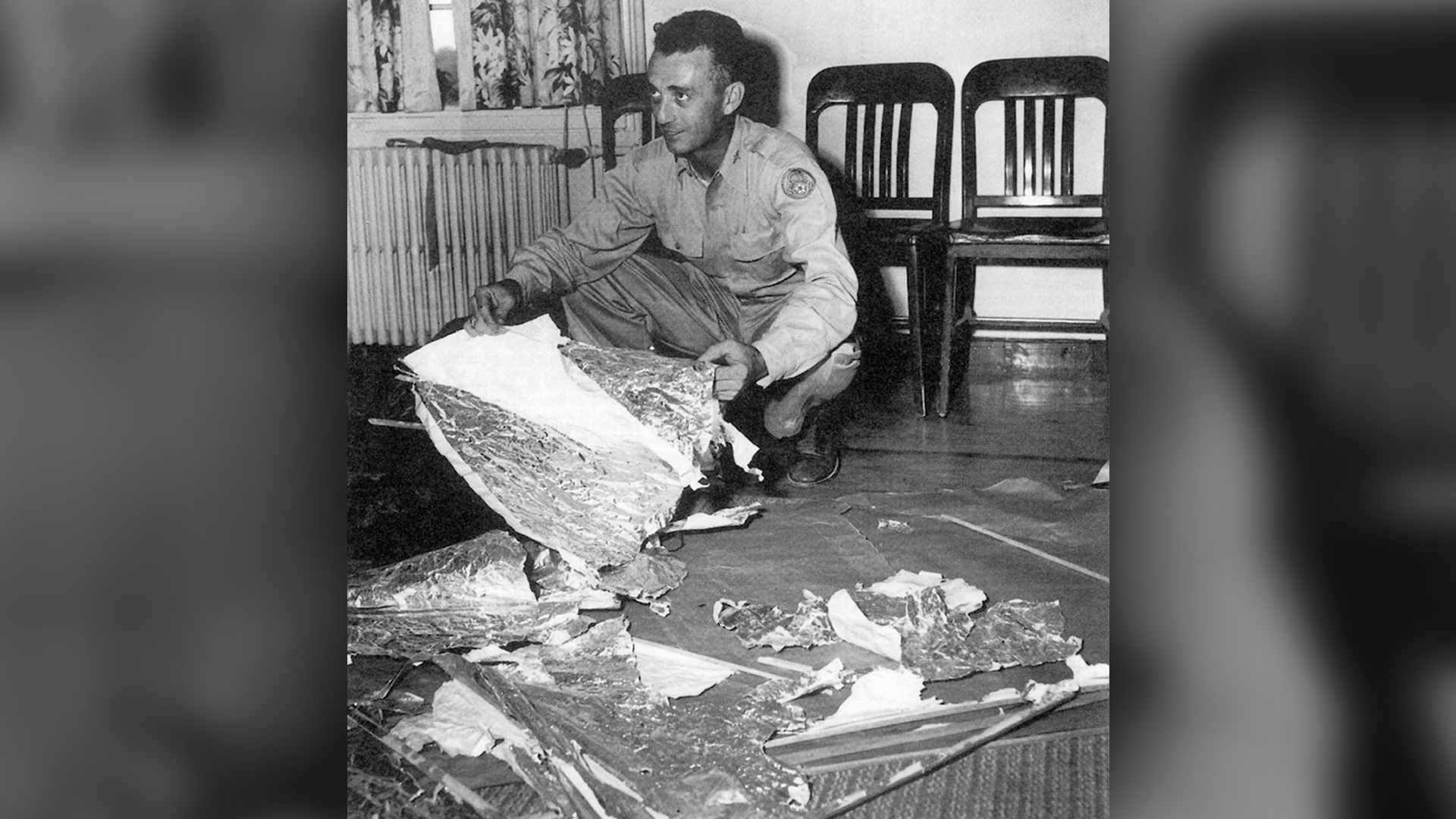
Military personnel examine debris from the Roswell crash site, 1947. Officially explained as a balloon, the incident fuels controversy and speculation.
Roswell 1947: Investigating the Government's Alleged UFO Cover-up
In July 1947, the quiet New Mexican town of Roswell became ground zero for one of the greatest mysteries of the 20th century. A suspected UFO crash ignited a firestorm of alien conspiracy theories and accusations of a sprawling government cover-up that persists to this day. Delve into the tangled web of intrigue, classified military projects, and the insatiable public curiosity that keeps this story alive.
What Happened
On a warm summer night in early July 1947, something fell from the sky near Roswell, New Mexico, a small town on the American frontier that would soon become synonymous with the extraterrestrial. July 2nd saw a powerful thunderstorm sweep across the region, its lightning illuminating the vast desert expanse and concealing the mystery about to unfurl.
By July 5, an unsuspecting ranch worker named Mac Brazel discovered peculiar debris scattered across the Foster Ranch property. This was no ordinary wreckage—a collection of lightweight metal strips and rubber unlike anything he had encountered in his years of tending the land. These irregular materials resisted bending or burning, characteristics so strange they fuelled speculation and unease among locals. Recognizing the importance of his find, Brazel collected samples and traveled into Roswell to share his discovery.
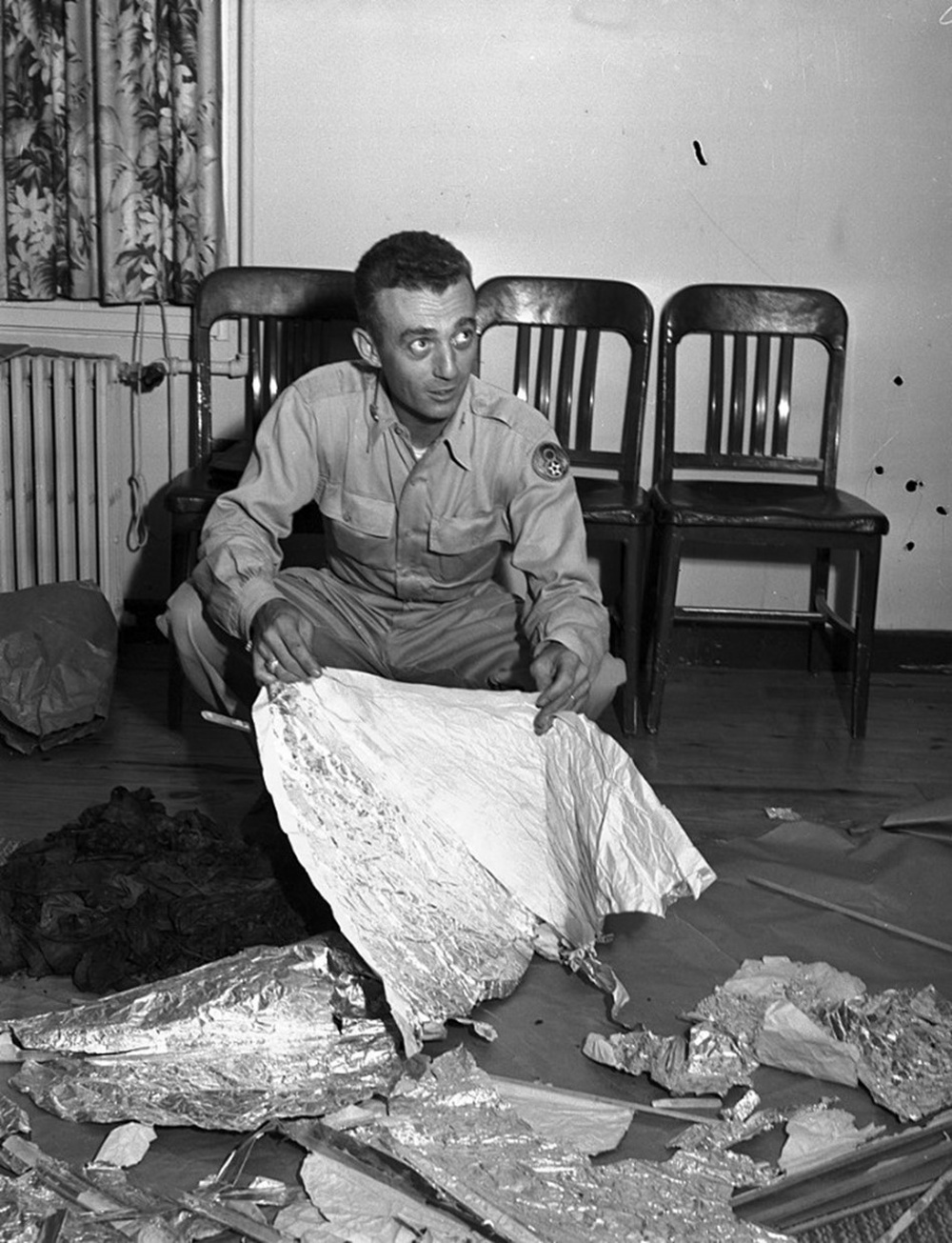
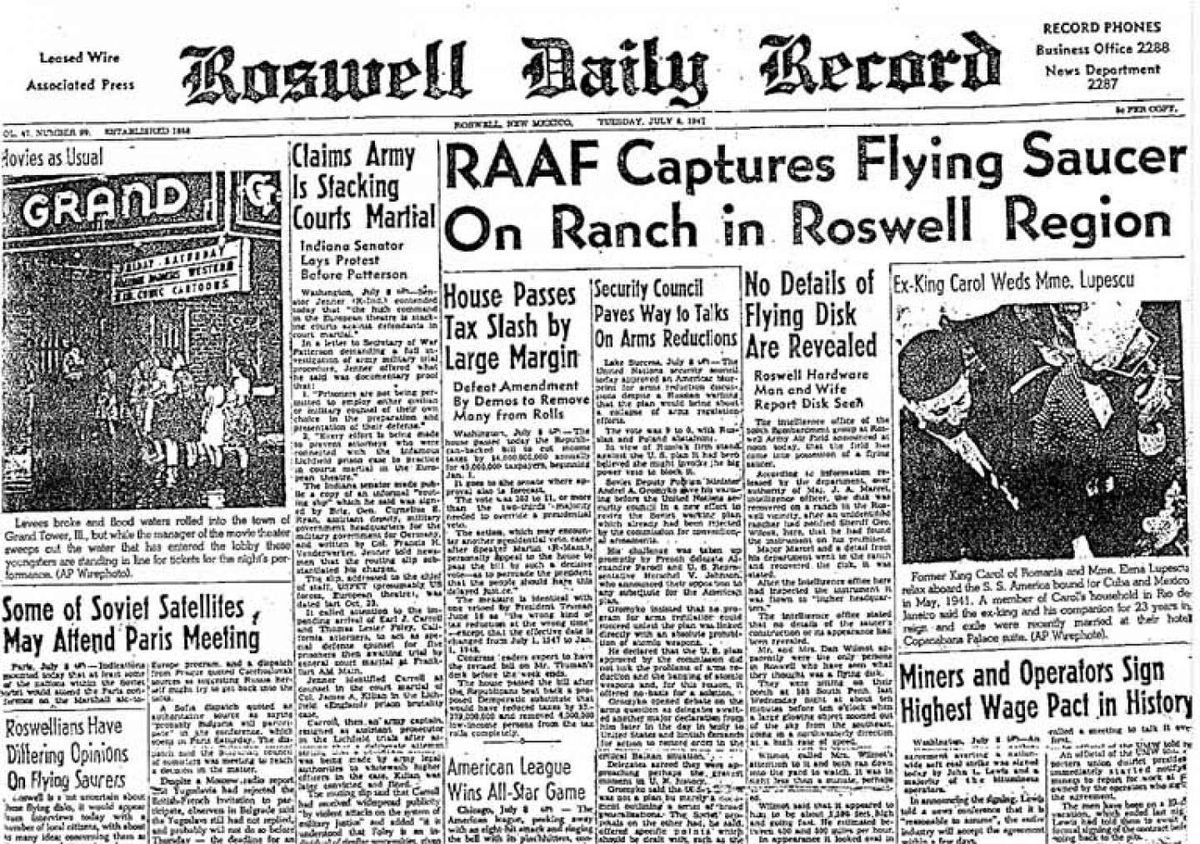
Local law enforcement contacted the Roswell Army Air Field, positioning Major Jesse Marcel at the forefront of the burgeoning mystery. As an intelligence officer, Marcel was dispatched to investigate the wreckage site, a task he later recounted as witnessing materials that defied earthly identification. The examination urged a swift action: on July 8, a release from the Roswell Army Air Field claimed the recovery of a ‘flying disc,’ a statement that radiated through the global press like wildfire.
Celebrations by UFO enthusiasts were abruptly curtailed when General Roger Ramey of the Eighth Air Force, stationed in Texas, oversaw a retraction—the debris was merely a misidentified weather balloon, part of a classified military operation. The original narrative clamped shut, but rather than quelling curiosity, it sparked conspiracy theories and incited bewilderment that would span decades.

The initial chapter of the Roswell saga closed with governmental explanations and public proclamations burying the incident under layers of official secrecy. Nonetheless, whispers of government obfuscation, coupled with impassioned narratives of eye-witness accounts, continued to breed suspicion and speculation. Continually stoked by media sensation and declassified military programs like Project Mogul, intended to listen for Soviet nuclear tests, the ‘Roswell Incident’ remained an unfolding enigma.
To this day, the story of a desert evening gone askew lingers, full of half-buried and partially remembered truths. Caught between a classified military age's specters and post-war New Mexico's constrained realities, it stands as a landmark event that provokes as much present intrigue as the dreams and fears of yesteryear.
Timeline of Key Events
1947 — Mac Brazel discovers unusual debris on a ranch near Roswell.
July 5, 1947 — Brazel reports his find to the local sheriff's office.
July 8, 1947 — Roswell Army Air Field issues a press release claiming recovery of a flying disc.
July 8, 1947 — Later that day, military retracts story, stating it was a weather balloon.
1978 — Jesse Marcel speaks publicly claiming the 1947 event was covered up by the military.
1980 — 'The Roswell Incident' book publishes, rekindling public interest.
1994 — The U.S. Air Force releases a report stating the Roswell debris came from Project Mogul.
1995 — Allegations surface of alien autopsies connected to the incident; footage later debunks.
1997 — 50th anniversary sparks symposiums and exhibitions worldwide.
2002 — The History Channel airs a documentary further contesting the official story.
2007 — New Mexico commemorates Roswell with an annual UFO Festival.
2011 — Dr. Roger Launius presents an expert talk on the historic Roswell incident.
2012 — More alleged witnesses come forward, adding conflicting testimonies.
2015 — Declassified documents confirm details of Project Mogul.
2019 — A gathering of scientists and UFO enthusiasts mark yet new questions.
2022 — A new witness confesses a fabricated story under pressure.
2024 — Heritage groups propose a Roswell site preservation.
2025 — Continued public interest leads to another Congressional review.
2026 — Historians highlight Roswell's impact on UFO culture around the world.
What Is Documented
The Roswell incident stands as one of the most analyzed and documented UFO encounters of the 20th century, attracting attention not only due to its dramatic nature but also due to the breadth of official reports and testimonies that continue to emerge. The initial Roswell Army Air Field press release on July 8, 1947, remains a foundational touchstone in the event's documentation. This announcement, penned by Walter Haut, took the bold step of confirming the recovery of an otherworldly 'flying disc.'
However, hours later, General Roger Ramey quickly dismantled this claim in a Fort Worth press conference, redirecting public attention to the mundane conclusion of a weather balloon mistaken as anything more exotic. This stark reversal threaded uncertainty into the narrative, and years later, documents declassified in the 1990s shed light on this contradiction by revealing the existence of Project Mogul.

Project Mogul was officially part of a top-secret U.S. military effort tasked with long-distance, high-altitude equipment designed to detect Soviet nuclear detonations—a vital Cold War initiative. Materials utilized for these operations included microphone-equipped balloons, yielding debris consistent with that found in Roswell. Despite these clarifications, the project's classified nature at the time necessitated the military's diligent, albeit misleading, communication strategy.
Congressional hearings have since revealed testimony and reports swathed in controversy. While figures like Marcel later argued discrepancies between official and private perceptions, documented evidence through governmental release holds steadfast in its dismissal of an extraterrestrial explanation. The juxtaposition of classified operations, public intrigue, and deliberate occlusion has made Roswell an enduring subject for both factual investigation and speculative interpretation.
What Has Been Alleged
Allegations surrounding the Roswell incident brim with anecdotes of extraterrestrial involvement and clandestine government operations. Among the most sensational claims are those of alien bodies recovered from the crash site, assertions that inject the narrative with a distinct sci-fi allure. These claims often originate from reported first-hand accounts by supposed military insiders or witnesses pressured into silence.
In the explosive environment of the late 1970s, nuclear physicist and ufologist Stanton Friedman pushed these clandestine rumors into mainstream consciousness. Through interviews with Jesse Marcel—a man central to the initial investigation—Friedman reshaped popular understanding, positioning Roswell as a hub of extraterrestrial intrigue despite the military's clipped retelling. Marcel's insistence on the unusual properties of the debris fueled ongoing debate and debates.
The 1995 release of the 'Alien Autopsy' film perpetuated further allegations, depicting fictionalized dissections conducted on purported alien corpses. Despite the film's ultimately debunked authenticity, it sparked a unique cultural fervor that questioned the U.S. government’s narrative once more.
Reports commissioned by the General Accounting Office (GAO) in the 1990s aimed to quell these allegations through thorough scrutiny. They maintained there was no evidence substantiating claims of extraterrestrial recovery or autopsies. Yet, the persistent allure of these allegations demonstrates how easily public imagination can leap over hurdles of evidential deficiency, driving home the narrative of a grand, concealed reality, barely beyond reach yet tantalizingly persistent.
What Remains Disputed
Contention over the Roswell incident thrives on the chasm between official governmental records and the more provocative claims posited by UFO supporters. The original incident reports fell into obscurity under the smothering blanket of Project Mogul—a strategic operation enveloped in Cold War secrecy, crafted to disguise sensitive reconnaissance missions.
Disputes arise most prominently with the conflicting accounts regarding the physicality of materials found at the Brazel ranch. As Major Jesse Marcel later insisted, the tactile quality of the recovered debris was unearthly, a statement at odds with the lighter-than-expected resolution of material identified by Project Mogul documents. Marcel's accounts counterbalance those of government officials who staunchly stood by the routine, albeit misidentified balloon account relayed by General Ramey.
Each side entrenches further through their justifications: skeptics rally around the science-rooted presentations found within volumes of declassified reports, while proponents turn to the emotionally charged testimonies of individuals who claim direct observation or knowing the participants personally. These divergent paths provide fertile ground for disputations that promise neither acquiescence nor finality, but rather further complexify an already dense tapestry of claimed reality.
What Was Later Confirmed
Subsequent revelations through declassified files have brought clarity to some aspects of the Roswell mystery, though they continue to tantalize rather than satisfy public curiosity. Key among these is the explicit acknowledgment of Project Mogul, the heretofore undisclosed military research operation run during that period—designed to monitor nuclear activity by harnessing high-altitude surveillance balloons.
The July 1994 report by the Government Accounting Office (GAO) valued as a vital turning point, detailed both directly and indirectly confirmations of how the operational procedures inherent in Project Mogul aligned with the initial reports of debris characteristics. The heavy emphasis placed on secrecy due to Cold War pressures meant that the public—and even some involved military personnel—were kept in the dark about essential government activities, lending credence to cover-up narratives.
Such confirmations have prompted new examinations into how the shadowy grasp of national security pervades even non-threatening inquiries like UFO sightings. The declassification encouraged a re-evaluation of historic narratives, further engaging public insistence in demanding greater transparency on issues once considered fringe. While many questions regarding Roswell still linger unexplored, confirmations of objectives and intent behind critical programs provide partial answers long kept hidden, sparking both relief and renewed queries among analysts and sceptics alike.
Common Myths & Exaggerations
In Roswell's haze of mystery, a number of myths have emerged, thriving in the vacuum created by half-told truths and shadowy governmental operations. One enduring myth proposes that US authorities have engaged, historically or presently, in secretive collaborations with extraterrestrial beings—a narrative with little more than speculative roots but popularized across various media.
Another myth indulges in the fantastical notion that alien technology recovered from Roswell was reverse-engineered to spearhead advancements in human technology, particularly during the Cold War era. Although captivating, such claims remain unsupported by empirical evidence, often contradicting open scientific developments that concurrently occurred worldwide.
Also prevalent are spurious accounts surrounding purported alien autopsies, exacerbated by the 'Alien Autopsy' film, whose staged images transfixed audiences in the mid-'90s. Thorough investigations exposed these as fabricated visual spectacles, highlighting the susceptibility of public opinion to manipulation through dramatized, erroneous convictions.
Such myths, although lacking rigorous support, offer a testament to Roswell's cultural viability. They reflect society's desire to confront ambiguous occurrences with fantasy and suspicion in the absence of authoritative satisfaction, providing a theatrical canvas upon which shared intrigue can unfold unrestrained by concrete validity.
Why It Matters
The Roswell Incident holds significant weight not just because of its curious beginnings but as an exemplar of wider themes concerning government transparency, public scrutiny, and the handling of unidentified phenomena. It serves as an insightful study on how the intersections of mystery and authority catalyze dialogue in democracies that espouse openness and accountability.
This case foregrounds conversations on the rights citizens have to governmental transparency versus the state's prerogative to maintain secrecy in the interest of national security—a debate relevant today amid evolving technologies that challenge conventional boundaries of air and space.
Further, the perpetual allure of Roswell reveals the cultural dynamics in myth-making, whereby societal narratives take shape and persist across generations. By offering a yardstick against which new UFO encounters are measured, it holds lessons on messaging, trust, and the importance of grounded disclosure in quelling vast conjecture, critical in an age where information is simultaneously at a premium and compromised in reliability.
Roswell also proffers implications on civil liberties and how emerging aeronautical phenomena should be approached policy-wise, in line with advancing dialogue reflecting on similar incidents, such as recent examinations of unidentified aerial activities receiving declassified endorsement and investigation by aerial defense project committees, moving conversations from the periphery to accepted exploratory realms.
Connections to Other Archive Entries
Roswell exists as part of a broader tapestry woven from countless strands of military secrecy and public fascination with the unknown. Related narratives include Project Blue Book, a substantial U.S. Air Force undertaking examining more than 12,000 claimed UFO sightings between 1952 and 1969, marking another staunchly surveilled cross-boundary engagement motivated by atmospheric suspicion.
The event ties closely with other murky incidences—like the Battle of Los Angeles in 1942—which revealed wartime exigencies between capability and mystery, etching never-to-be-forgotten chapters into wartime memory. Both speak to historically entrenched dialogues braided with technological advancements and defense posture, where Roswell's legacy continues to imprint itself on the collective American conscience, inflecting interpretations of the unknown and the unexplored as potent questions in need of tangible answers.
In sum, Roswell not only narrates a story of extraterrestrial debate but also punctuates the narrative of when and why governing entities interact with the public around questions of mystery and scientific pursuit.
Sources & References
PRIMARY SOURCES
SECONDARY SOURCES
The Hidden History Archive is part of The Beacon Wire entertainment and informational platform. All archive articles are based on public sources, declassified documents, court records, and reputable journalism. Facts are clearly separated from allegations, disputed claims, and unsupported speculation. Nothing in this archive should be interpreted as legal advice or as incitement to harm. Readers are encouraged to consult primary sources directly.
We use cookies to improve your experience and analyze site usage. See our Cookie Policy for details.