Photograph of Maj. Jesse A. Marcel posing with wreckage, July 1947.
Unveiling Roswell: The 1947 UFO Crash & Government Cover-Up
In 1947, a mysterious crash near Roswell, New Mexico, ignited decades of fervent speculation. Was it a weather balloon or an extraterrestrial craft? This article unravels the bewildering tangle of evidence, allegations, and governmental intrigue that still haunts the corridors of power today.
What Happened
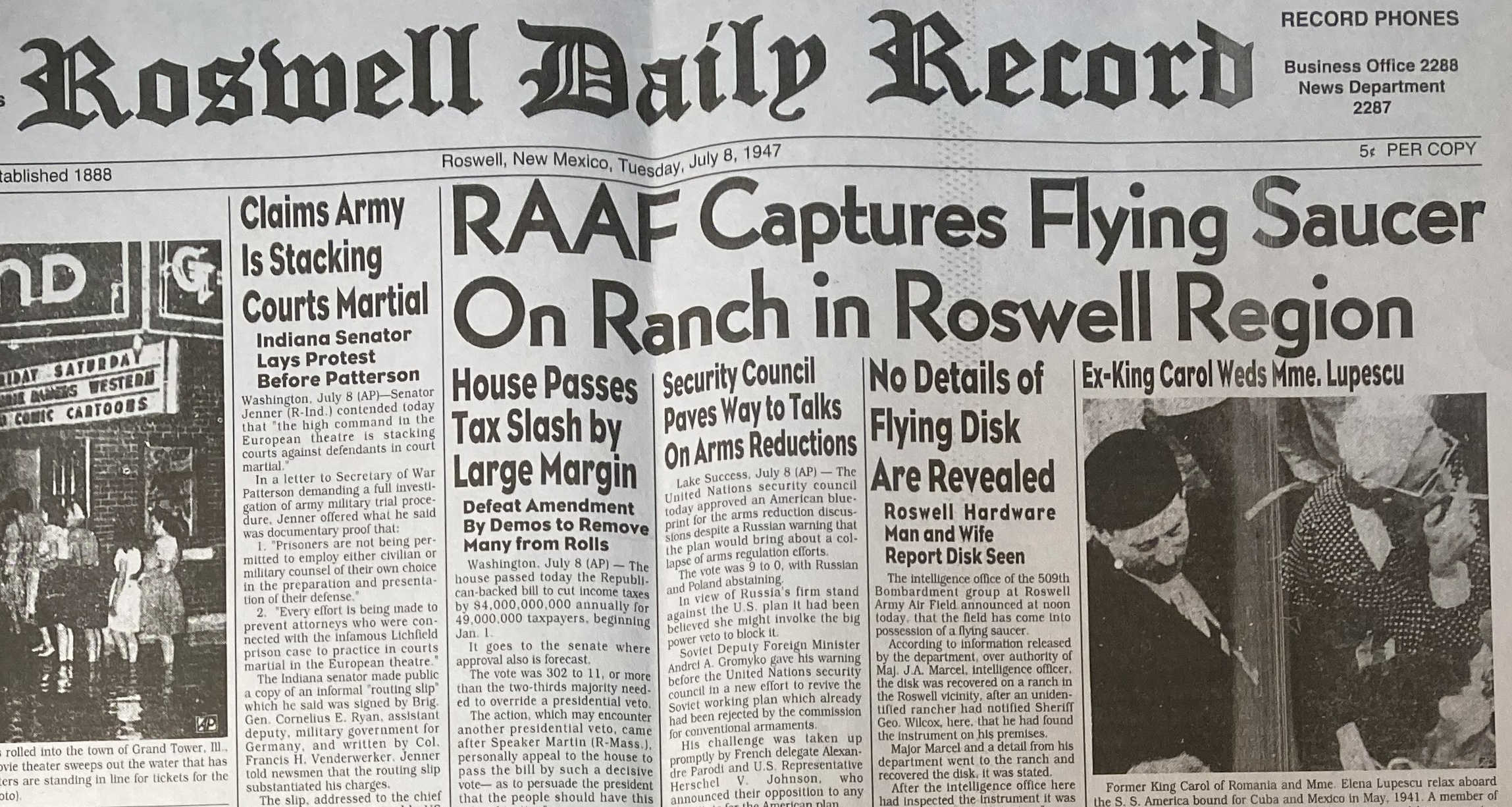
July 8, 1947. What was purported to be an ordinary summer evening in the sleepy town of Roswell, New Mexico inexplicably transformed into a chapter of enigma that continues to vex historians and conspiracy theorists alike. On this sweltering day, the Roswell Army Air Field (RAAF) issued a press release stating they had recovered a 'flying disc' from a nearby ranch. The news reverberated rapidly, causing a national sensation and sowing the seeds for a controversy that would endure for decades. Shortly thereafter, the public narrative took a jarring turn as the Army Air Force swiftly retracted its earlier statement, replacing the story of the 'flying disc' with a more mundane explanation: it was simply a weather balloon.
This rapid pivot from an extraordinary claim to an ordinary explanation sowed seeds of suspicion among the public. The stakes heightened as local newspapers, such as the Roswell Daily Record, emblazoned their front pages with the initial announcement. Rancher William Brazel, whose property played host to the crash site, reported finding a cacophony of debris—a curious blend of rubber, tinfoil, and rather unearthly materials—with an unsettling tale of the military swiftly descending upon and confiscating the materials.

Key figures soon emerged in this enigmatic tapestry. Major Jesse A. Marcel, the RAAF intelligence officer whose duty it was to examine the wreckage, became a central player. Marcel allegedly claimed that what he saw at the site wasn’t merely terrestrial refuse, but something from beyond the stars. His opposing declarations—first, supporting the wreckage as revolutionary and extraterrestrial, then towing the official line of a weather balloon—added layers to the growing intrigue.
The so-called official narrative, relayed through the oration of Brigadier General Roger Ramey at a press conference held in Fort Worth, Texas, depicted Marcel holding mere fragments of mundane weather equipment, driving the tale out of the realm of fantasy and back into the plausible, at least on the surface. Yet, years later, Marcel's family and some supporters would chart an entirely different course, claiming his original assessment had been truthful, later coerced to recant under official pressure.

While the U.S. Air Force would issue comprehensive reports decades later, epitomized by 'The Roswell Report: Fact vs. Fiction in the New Mexico Desert,' these publications did little to assuage the fervor. They contended that the wreckage stemmed from Project Mogul, a top-secret initiative employing high-altitude balloons to detect Soviet nuclear tests. However, confirmation of such an explanation emerged only after the Cold War haze dissolved slightly, affording historians a clandestine peek into erstwhile classified endeavors.
The Roswell Incident's true nature—its extraterrestrial allure or government obfuscation—remains shrouded in obscurity. Even now, enthusiasts gather at the annual Roswell UFO Festival, some bolstered by recent declassified documents from the Trump administration hinting at the presence of alien technology. Was Roswell merely relics of a bygone era's Cold War scheming? Or do echoes of alien echoes linger, buried beneath secrets and whispers?
Timeline of Key Events
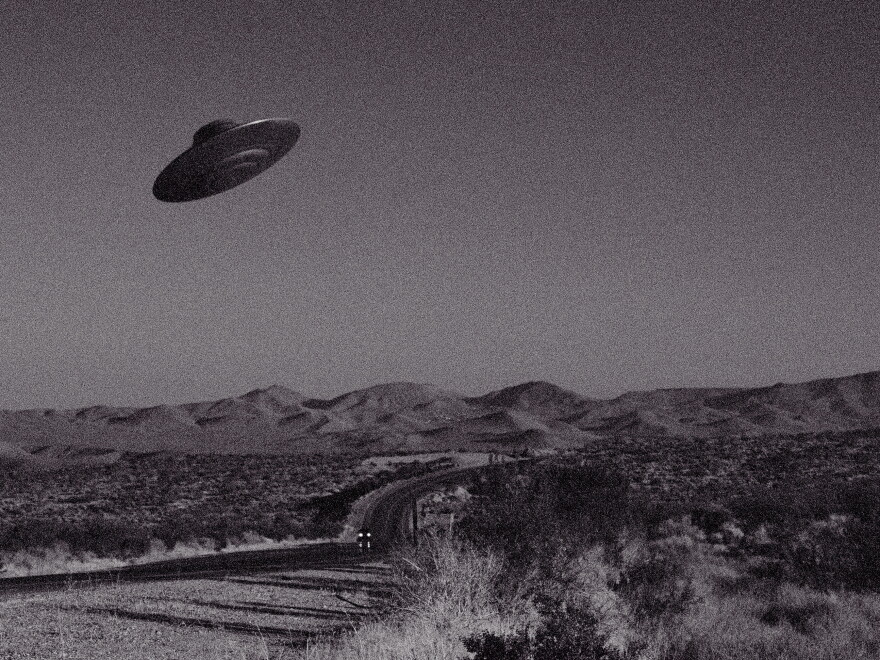
1947 — A mysterious object crashes near Roswell, New Mexico. The Army initially reports recovering a 'flying disc.'
1947 — The military retracts its claim, stating the object was a weather balloon.
1947 — Maj. Jesse A. Marcel investigates the crash site. He describes the debris as otherworldly.
1947 — Brig. Gen. Roger Ramey displays the debris in a Fort Worth press conference, labeling it weather balloon parts.
1947 — The Roswell Daily Record publishes initial claims about an alien craft.
1950 — A FBI memo is written speculating about captured 'flying saucers.'
1952 — The USAF creates Project Blue Book to investigate UFOs.
1980 — 'The Roswell Incident' book reignites interest and theories of a cover-up.
1994 — U.S. Air Force releases 'The Roswell Report,' explaining Project Mogul as the crash's source.
1995 — Sens. Jeff Bingaman and Richard Shelby call for more information on Roswell.
1997 — USAF publishes 'The Roswell Report: Case Closed,' reiterating the Project Mogul explanation.
2002 — NASA explores opening investigation into alien life sanitation protocols linked to Roswell.
2005 — New witnesses, like former mortician Glenn Dennis, claim to have seen alien bodies.
2011 — Former CIA agent Chase Brandon purportedly confirms extraterrestrial origins off-record.
2017 — The Pentagon admits funding Advanced Aerospace Threat Identification Program to study UFOs.
2018 — Defense Intelligence Agency declassifies documents on UFO encounters.
2021 — Congress mandates the Office of the Director of National Intelligence examine UFO data.
2023 — Senate hearings on UAPs continue, with references to Roswell.
2025 — Trump administration declassifies alien document troves.
2026 — Roswell remains a focal point of UFO speculation and government conspiracy debates.
What Is Documented
In the days following the purported crash, official records were swiftly produced, casting a new light on the curious happenings near Roswell, New Mexico. On July 8, 1947, Roswell Army Air Field (RAAF) issued a press release claiming the recovery of a 'flying disc,' a statement generating widespread attention. Major Jesse A. Marcel was dispatched to investigate the wreckage, reporting materials that included curious metals with indestructible properties and an unsettling, unearthly texture.
Hours later, in a complete about-face, Brigadier General Roger Ramey held a press conference revealing that the debris had been misidentified. In a photo opportunity, Marcel was shown cradling fragments of a weather balloon—sheets of tinfoil, rubber, and flimsy sticks.
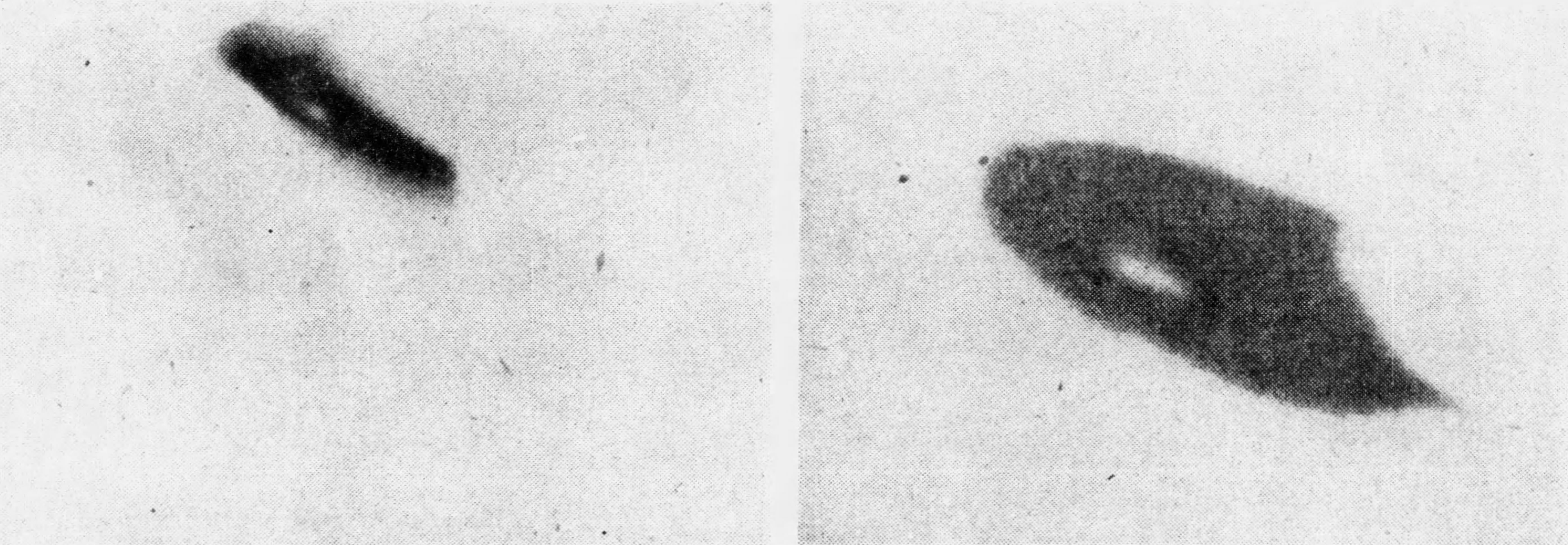
In 1994, the U.S. Air Force published 'The Roswell Report: Fact vs. Fiction in the New Mexico Desert,' finally declassifying previously hidden elements linked to Project Mogul—a clandestine operation utilizing high-altitude balloons equipped with microphones to detect Soviet nuclear tests.
The Mogul Project explanation was further reinforced by a second report in 1997, 'The Roswell Report: Case Closed,' dismissing notions of crash-landed extraterrestrial conveyances. Although it accepted the possibility that initial reports may have been influenced by Cold War paranoia, the assertion was that eyewitness misconceptions arose from complex balloon mechanisms.
Despite the divulgence of these reports, fervent scrutiny continues. Declassified documents from the Defense Intelligence Agency (DIA) regarding UFO encounters have added new dimensions, providing tantalizing blanks for skeptics to compulsively fill. Meanwhile, formal records from both the Senate and House Intelligence Committees catalyzed broader inquiries into Unidentified Aerial Phenomena (UAP), lingering around the ever-elusive question of what truly transpired in the desolate Roswell desert those seven decades ago.
What Has Been Alleged
The gravitational pull of Roswell's story is further accentuated by the labyrinth of allegations that intertwine with documented accounts. There are those who fervently claim that an actual alien spacecraft met its demise on the New Mexican soil. Proponents like Dr. Steven Greer have championed the extraterrestrial argument, suggesting that alien bodies were recovered and subsequently spirited away by government operatives to secure facilities such as Wright-Patterson Air Force Base.
Glenn Dennis, a former mortician linked with Roswell's Ballard Funeral Home, confessed in the late 1980s to witnessing child-sized alien bodies. Dennis alleged that an acquaintance, a nurse at the Roswell Army Air Field's infirmary, described seeing military-medical personnel examining humanoid remnants.
Further allegations emerged from Kevin D. Randle, a prominent ufologist, suggesting that Roswell was the epicenter of a powerful, secretive conspiracy. Randle hypothesized the existence of a covert government protocol aimed at discrediting witnesses or intimidating them into silence, underscoring the official narrative and marginalizing tangential claims.

Unlike the confronting revelations of the Watergate or the Pentagon Papers, Roswell thrives in an ambiguous netherworld, where myth and allegations intermingle. Centuries have passed since the event, yet whispers and allegedly suppressed testimonies endure as fervent calls for transparency continue. The extraordinary nature of Roswell's claims demands undeniably authoritative evidence, yet the purported official reticence lives on as a shadowy hallmark.
Though formalized reports have been published, drawing from declassified resources under Congressional purview, the specter of unresolved, unprovable allegations endures, beckoning enthusiasts and skeptics alike. These alleged truths, steeped in persistence, ensure that Roswell remains at the apogee of contemporary ufological scrutiny.
What Remains Disputed
The Roswell incident stands as a perennial confluence of contradictions, juxtaposed between the concrete and the ethereal. One satellite of contention lies within the dual narratives supplied by official military channels and impassioned civilian witnesses of the time. Where the Army describes simple balloon debris, others articulate tales of an alien presence.
Major Jesse A. Marcel’s conflicting statements have been the nucleus of much contention. Initially proclaiming the contents of his findings as anomalous, he reportedly retracted his observations following the involvement of higher military authority. In years to come, his reiterations of the 'truth,' infused with claims of coercion, have wormed into debates over the reliability of eyewitness testimony clouded by psychological stress or external pressure.
The accounts provided by Glenn Dennis and his assertions of alien cadavers have been met with skepticism by researchers, including Robert A. Irion and Timothy Good, who point to inconsistencies and lack of corroborated evidence. The military adamantly denies these claims, maintaining no records of such discoveries or operations.
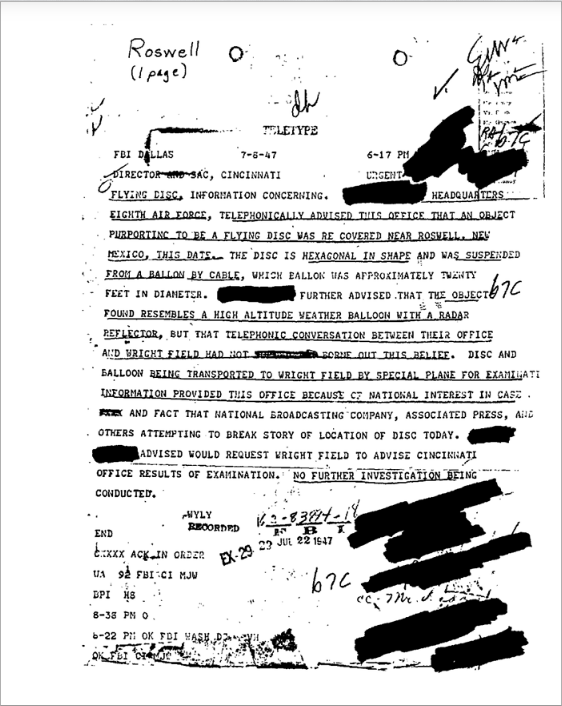
Even 'The Roswell Report: Case Closed,' compiled by the United States Air Force, has faced critiques from ufologists and scholars alike, accusing the report of oversight regarding discrepancies between interviews of that era’s participants and documents from declassified archives. The veracity of this information continues to be subjected to minute scrutiny, oscillating between acceptance and disbelief, sewing together a complex tapestry of truth and embellished fiction.
What Was Later Confirmed
Roswell’s layers of mystery encrypted within government files began to fray with subsequent declassification efforts. Originally, the United States government stood firm on the assertion that the remnants uncovered were no different than a conventional weather balloon, yet the shrouded roots of this narrative began to unravel over the ensuing decades.
In 1994, following direction from the General Accounting Office (GAO), the Department of Defense tasked the Air Force with an inquiry into the now-iconic incident. This investigation unearthed evidence relating to Project Mogul—an endeavor cloaked in Cold War secrecy aimed at distant Soviet atomic activities. The revealing of Mogul suggested the remaining so-called flying disc was indeed a collection of radar reflectors and atmospheric balloons attending to clandestine detection.
Roswell had thus served as an unwitting linchpin in operations indicative of the era’s geopolitical paranoia. What was initially labeled as slipshod instrumentation or 'swamp gas' assumed a place among the psychological arsenal of post-war politics.

More compelling was the 2021 issuance of reports by the Office of the Director of National Intelligence (ODNI) concerning UAPs, tethering recent phenomena to the past. The intelligence community uncovered new documentation, briefings, and hearings that affirmed prior suspicions that governmental acknowledgment had previously lagged amid concerns over national security.
In this light, the skepticism-riddled Rip Van Winkle of Roswell received partial resurrection in substantiation and reaffirmation by archival revelation—yet the chasms of gaps cannot be dismissed, begging for resolution.
Common Myths & Exaggerations
The terrain surrounding Roswell is littered with misconceptions and narratives spun into memory by disparate sources. Among these storied accounts speaks the rhythmic legend of an interstellar crash site, complete with extraterrestrial survivors—an uncorroborated myth absent from official documentation.
Some perpetuate the capability of tinfoil-clad wreckage to assume aerodynamically impossible shapes recoiling from any environmental constraint, presented as evidence of unnatural origin. In truth, these descriptions can often be traceable to reflective panels integrated into Project Mogul’s equipment, designed to confuse radar signals rather than spirit them away.
The presence of alien autopsies, particularly following films feigning reality such as the 1995 'Alien Autopsy: Fact or Fiction,' is a notion the Air Force has fervently disputed as a fabricated entertainment farce. Skeptics have continuously pointed to Hollywood glamorizations that clutch upon skulking shadows but fear the light of rigor and empirical study.
One of the most entrenched falsities asserts that the Roswell wreckage and recovered craft were hastily transferred to Area 51, a military base in Nevada long enshrined in extraterrestrial lore. While Area 51 certainly exists, inflamed imaginations vastly overstate its association with the Roswell event, as no documentation links them directly.
Rather than embarking upon a quest for truth, these fabrications distract from the veracity-laden inquiries required to decipher the truths so long embroiled in mysticism.
Why It Matters
The Roswell incident may seem like the stuff of mid-20th-century legend, yet its repercussions extend tentacles well into contemporary discourse. At the heart of its enigma are questions about governmental transparency and the public’s right to knowledge—a precursor to wider national dialogues spanning from the Vietnam War to the Iraq War Weapons of Mass Destruction (WMD) controversies.
This episode highlights the balance between national security and individual liberties, setting precedents that resonate across civilian-military relationships to this day. The pattern of governmental reticence, occasional deception, and selective disclosure echoes through halls of power, being visible in the surreptitious intelligence operations of modern-day intelligence-gathering agencies.
The pervasive suspicion engendered by Roswell fosters a wider cultural scepticism, apparent in debates ranging from federal scientific endeavors to climate change dialogue. Claims of Roswell’s secretive overreach nurture a societal reflex to demand vigilance against potential abuses of power—a necessary safeguard in democratic frameworks.
UAP investigations by Congress and the subsequent tide of hearings underline public captivation fueled by years of Roswell mythos, showcasing how even decades-past events can steer legislative attention and research funding in aerospace technology and extraterrestrial inquiry.
Ultimately, Roswell functions as both object lesson and lens through which broader motifs of secrecy, authority, and autonomy illuminate the shadowy interplay of factors influencing historic and cutting-edge decision-making. The past continues to edge into the present, dripping through the ages, reconstituting modern reality.
Connections to Other Archive Entries
The Roswell incident aligns with other significant government cover-ups and intelligence operations involving secrecy and misinformation, such as the Pentagon Papers and MKUltra experiments, which showcased systemic patterns of deceit and unilateral decision-making.
Similarities can be seen in narratives surrounding the Kennedy Assassination, where witness silencing and conspiratorial smokescreens are topics of fervor that parallel Roswell’s own legends of societal suppression and cryptic maneuvering.
Operational tactics from the Cold War era, including Project Greenglow and espionage strategies within Iron Curtain geopolitics, replay themes emblematic of Roswell’s unfolding. These representatively showcase how Cold War intelligence shaped interpretations of unidentified phenomena and influenced international spying precedents.
Roswell’s linchpin remains an enduring symbol, a veritable Pandora’s box through which contemporary discoveries occasionally seep—inviting comparisons amid vast networks where allegiances and adversarial postures have threaded shared history.
Sources & References
PRIMARY SOURCES
SECONDARY SOURCES
The Hidden History Archive is part of The Beacon Wire entertainment and informational platform. All archive articles are based on public sources, declassified documents, court records, and reputable journalism. Facts are clearly separated from allegations, disputed claims, and unsupported speculation. Nothing in this archive should be interpreted as legal advice or as incitement to harm. Readers are encouraged to consult primary sources directly.
We use cookies to improve your experience and analyze site usage. See our Cookie Policy for details.