
The historic 1994 Congressional hearing with tobacco industry executives, a pivotal moment in unveiling their deceit.
The Tobacco Industry's Great Deception: A Deadly Cover-Up Revealed
For decades, the tobacco industry masked the lethal truth: cigarettes cause cancer. This is a shocking tale of corporate manipulation, suppressed findings, and the relentless battle for public health—a saga where the stakes meant life or death.
What Happened
Picture this: the year is 1950, and a groundbreaking study just shook the world. British researchers, Dr. Richard Doll and Sir Austin Bradford Hill, published their findings linking smoking to lung cancer, a revelation that would forever shift the landscape of medical research surrounding tobacco's health effects. But lurking in the shadows, the tobacco industry set in motion a relentless campaign to subvert and counteract these troubling truths. As scientific consensus solidified over the ensuing decades, studies from all over cast a glaring spotlight on tobacco's insidious dangers. Yet, the industry remained unwavering in its resolve to muddy the waters. Executives from companies like Brown & Williamson, Philip Morris, and R.J. Reynolds masterminded a strategy to manufacture doubt. They aimed to confuse the public and protect their profit margins against this onslaught of incriminating evidence. Enter the Tobacco Institute, a powerful trade association that spearheaded this duplicitous crusade. The Institute, in tandem with its offshoot, the Tobacco Industry Research Committee—later known as the Council for Tobacco Research (CTR)—funnelled millions of dollars into research. But this wasn't impartial science. It was a well-oiled machine designed to generate counter-narratives and question the emerging research linking tobacco to deadly diseases. Documents declassified during the sprawling legal battles of the 1990s peel back the curtain on this deception. They reveal scandalous emails, internal memos, and reports detailing the industry's complicity. Tobacco executives were well aware of the harm cigarettes posed but remained resolute in their deception. In one stark revelation, the infamous "Cigarette Papers" from Brown & Williamson laid bare over three decades of concealed knowledge about tobacco's harmful effects, meticulously hidden to shun regulatory attention. The industry's deceit finally came to a head in an avalanche of courtroom evidence, shaking the very foundation of the tobacco empire. It culminated in the 1998 Master Settlement Agreement, a monumental legal action requiring tobacco companies to cough up billions to states—a penance for their decades-long deception. Yet, this monetary recompense is but a mere echo of an incalculable cost: lives snuffed out prematurely and families shattered. And so, as the smoke begins to clear, the question remains—how many more lies are shrouded in the industry's smokescreen, and what lessons must we carry as we scour these ashes?
Timeline of Key Events
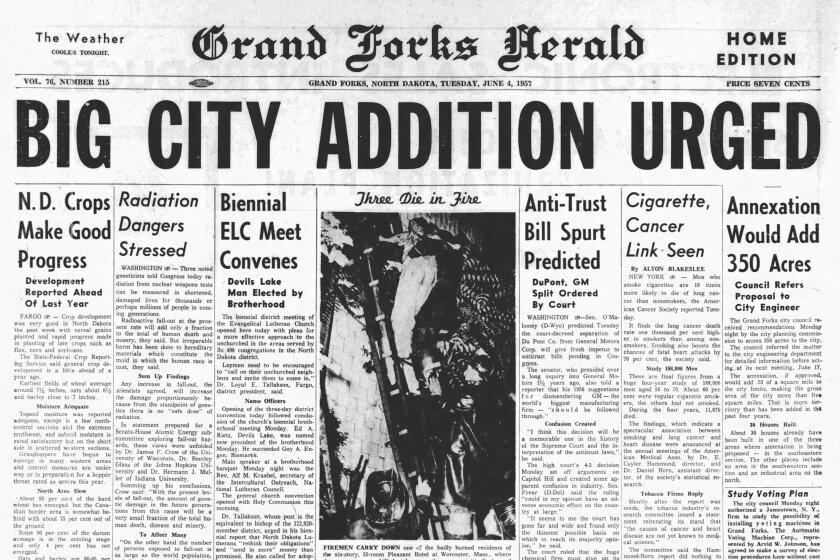
1950 — Richard Doll and Austin Bradford Hill publish a pioneering study linking smoking to lung cancer.
1953 — Tobacco company executives meet at the Plaza Hotel to discuss reports on cancer risk.
1954 — The Tobacco Industry Research Committee is formed to reassure the public about smoking safety.
1955 — Major tobacco companies launch a joint campaign titled 'A Frank Statement to Cigarette Smokers' proclaiming smoking's safety.
1964 — U.S. Surgeon General's report publicly declares smoking a definitive cause of lung cancer.
1967 — The formation of the Task Force on Tobacco and Health for further internal research.
1969 — The Council for Tobacco Research is formally established by the tobacco industry.
1970 — Public Health Cigarette Smoking Act bans cigarette ads on TV and radio in the U.S.
1971 — Leaked industry documents suggest executive awareness of cigarettes' addictive properties.
1978 — Document leaks reveal industry's suppression of scientific evidence on smoking.
1981 — A critical study emphasizes secondhand smoke’s dangers; tobacco companies actively contest findings.
1982 — An internal memo from Brown & Williamson uncovers cigarettes as 'vectors for cancer.'
1984 — Warnings appear on cigarette packaging in the U.S., leading to increased public skepticism.
1992 — An FDA investigation leads to further scrutiny on tobacco's health impacts.
1993 — The first class-action lawsuit against Big Tobacco in the United States, uncovering internal documents.
1994 — In a televised congressional hearing, seven CEOs deny nicotine's addictive nature under oath.
1996 — The Brown & Williamson 'Cigarette Papers' are published, revealing internal knowledge of health risks.
1997 — The state of Mississippi reaches a historic settlement with tobacco companies over healthcare liabilities.
1998 — The Master Settlement Agreement is finalized, involving 46 states and major tobacco companies.
2000 — The WHO Framework Convention on Tobacco Control is established to combat tobacco-induced diseases globally.
2009 — The Family Smoking Prevention and Tobacco Control Act grants the FDA regulatory power over tobacco products.
What Is Documented
Meticulously documented evidence from myriad sources confirms the tobacco industry's comprehensive cover-up campaigns. Detailed in what became known as the 'Tobacco Papers,' internal documents from Brown & Williamson and Philip Morris exposed that companies knew, as far back as the 1950s, of the carcinogenic potential of cigarettes. These documents were pivotal in legal battles during the 1990s, with the results culminating in the landmark Master Settlement Agreement of 1998. This settlement, documented extensively in legal proceedings, unveiled the industry's treacherous paths. They were subsequently released to the public in vast digital archives, including the Legacy Tobacco Documents Library. This plethora of information unveiled that billions were spent on public relations endeavors to foster skepticism and debate about smoking's dangers. The Council for Tobacco Research—purportedly established for genuine inquiry—was exposed as a conduit for influencing science, aiming only to inspire controversy and delay public policy decisions against smoking. The 1994 congressional hearing, a sequence forever etched in history, saw industry leaders swear—on record—that nicotine wasn't addictive, despite copious internal evidence and research substantiating the opposite. In disclosures unearthed through declassified communications, it became clear how ingrained the industry's disinformation campaign truly was. Systematically, the industry attempted to manipulate health policies, both domestically in the U.S. and globally, halting anti-smoking legislation through strategic financial contributions and leveraging influential connections. These discovered strategies revealed an insidious, premeditated operation aimed at maintaining and expanding tobacco's market share at the cost of public health.
What Has Been Alleged
Allegations swirling around the tobacco industry's influence extend deeply into the realm of cancer research and public policy. One of the most damning allegations involves the so-called 'whitecoat' project. Within several leaked documents, the industry allegedly collaborated with scientists, remunerating them handsomely to generate biased studies that would sow doubt and support industry claims. Consumer advocacy groups like Action on Smoking and Health (ASH) allege that the industry specifically engineered these undertakings to thwart genuine scientific consensus. Another grave allegation involves strategic marketing practices targeting youth and minority groups—populations perceived as keystones for market durability and growth. Allegations have surfaced that the industry employed deceptive strategies, incorporating flavors and attractive packaging explicitly designed to lure young customers into the ranks of smokers. Additionally, there are troubling claims about alleged sophisticated lobbying campaigns. Health advocates contend that tobacco companies have employed former high-ranking officials as lobbyists, leveraging their access to curtail regulation efforts and manipulate health policies. These alleged lobbying strategies reportedly involved direct financial transactions and vital favors. The tobacco industry, critics claim, has purportedly justified reversing or diminishing tobacco control measures on thin grounds of fair-trade policies. While these allegations build a formidable story of premeditated malfeasance, the industry's immense legal apparatus has wrestled adeptly to discredit accusers, seeking dismissal of the accusations through orchestrated PR maneuvers, and thus complicating any pathway to a conclusive narrative in the courtrooms of law.
What Remains Disputed
The tobacco industry's position on smoking—a conversation as contentious as it is historical—remains steeped in disputes. Companies have persistently challenged the verdict linking tobacco to cancer, despite the overwhelming body of independent evidence. Even in the face of damning and comprehensive studies from renowned institutions, tobacco corporations have stood firm in asserting either a lack of direct connection or raising the banner of scientific uncertainty. One of the pronounced points of contention revolves around internal knowledge versus public acknowledgment of the issues. Many assert documents uncovered during litigation conclusively show the industry's awareness, yet the companies hold firm that 'awareness' does not equate to 'knowledge during that era of industry standards'. The tobacco industry also staunchly contests accusations tied to marketing practices, specifically those targeting teenagers. Behind well-crafted public messaging lies a disputed truth. Companies present a façade of corporate responsibility, partaking in public health campaigns and self-regulation declarations, yet whistleblower testimonies and independent findings narrate a far different story—one of internal efficiencies and evaluations indicating active targeting of these demographics, starkly at odds with public claims. These disputes highlight the rift between industry pronouncements and independent counterpoints, showcasing how deeply entrenched corporate narratives have frictioned against advancing scientific communities.
What Was Later Confirmed
Initially cloaked in denials, many of the tobacco industry's claims evaporated under the harsh spotlight of public and legal scrutiny. For years, major tobacco companies obstinately denied any health risks associated with smoking, dispatching their legal and PR teams to unfurl a web of misinformation. However, the tide turned during the CIA-like document revelations of the 1990s. One critical turning point was the release of the 'Cigarette Papers' in 1996. These incriminating documents demonstrated that as early as the 1950s, industry giants were acutely aware not only of cigarettes' carcinogenic properties but also of nicotine's addictive nature. This bare-edged truth caused a seismic shift in public perception and regulatory action alike. Court rulings starting in the late 1990s began repeatedly affirming industry knowledge and complicity, unearthing documented admissions and memos strategizing not just against scientific validation but actively engaging in marketing cons targeting young consumers and questioning bona fide research integrity. As the Master Settlement Agreement unfolded, it set a legal precedence, additionally confirming the lengths to which tobacco companies were willing to go to weave fictitious narratives around the undeniable evidence that had gathered against them for nearly half a century.
Common Myths & Exaggerations
There is a slew of myths around the tobacco industry's activities related to cancer research and their broader impacts. Arguably, the most pervasive myth is the belief that filtered cigarettes offer substantial safety improvements over their unfiltered counterparts. This fallacy has been debunked time and again by scientific assessments demonstrating that filters do not significantly diminish health risks; instead, they often encourage deeper lung draws. The perpetuation of 'light' and 'mild' cigarettes being safer alternatives persists among public misconceptions. Investigative findings reveal that these terms were primarily constructed for marketing allure, offering no real health benefits. A more insidious notion misapprehends the tobacco industry's intentions in developing countries, suggesting that the industry has openly conceded smoking hazards in these territories. Conversely, information shows proactive, aggressive advertising tactics targeting these developing markets, supplying new customer bases where regulatory frameworks were stringently less mature. Finally, another exaggeration concerns that the tobacco industry has single-handedly pioneered deceit through its practices. While their endeavor forms a substantial part of this narrative, the techniques have been mirrored across sectors, from fossil fuels hindering climate change action to pharmaceutical giants deflecting side effect controversies.
Why It Matters
The tobacco industry's surreptitious efforts to conceal the lethal truths about smoking paint a grim but vital lesson in corporate accountability and public health advocacy. It highlights the devastating potential of unchecked corporate power. Through deception, obfuscation, and manipulation of ostensibly impartial scientific discourse, the industry delayed regulatory interventions that could have saved millions of lives. This historical episode has profound implications for contemporary policymaking. It informs discussions about how governments and boards regulate industries that possess detrimental public health consequences—be it Big Pharma, Big Data, or Big Tech. Each echoes the lessons inscribed in the tobacco saga, fueling critical changes in how corporations operate transparently and are held responsible by regulatory frameworks. Additionally, the tobacco industry's duplicity continues to resonate within the discourse on consumer awareness. In an age marked by misinformation, consumers now demand critical media literacy, deciphering between genuine and manufactured uncertainties in domains like environmental safety and public health. This industry’s past actions have not only entrenched skepticism in publicly distributed corporate information but have necessitated significant restructurings in transparent research credibility, advocating that legislation and regulatory bodies have stronger oversight on commercial research funding and declarations. The findings and outcomes from the tobacco cover-up infiltrated legal precedents that redefined the landscape for tackling deceptive advertising and unrealistic claims, actionable today against any sector exhibiting parallels. Ultimately, understanding this odyssey prevents history from repeating or manifesting in alternative forms in areas of public interest yet realized. It remains imperative not only to acknowledge these legacies but actively implement learned lessons within modern contexts to fortify against comparable exploitations.
Connections to Other Archive Entries
The tobacco industry's grand deception parallels several other high-stakes corporate entanglements throughout history. These interconnected stories typify broader themes about corporate influence and public policy intricacies. The fossil fuel industry, for instance, adopted strategies similar to the tobacco industry, sowing skepticism regarding climate change science to postpone regulatory interventions and protect economic interests. Similarly, parallels have been drawn in Big Pharma's approach to deflecting drug side effect criticisms, as well as in the sugar industry’s history of obfuscating its health risks. This commonality of method, now labeled broadly as the 'disinformation playbook,' serves as a powerful metaphor for analyzing contemporary corporate malfeasance. Recognizing these connections offers invaluable insight into identifying patterns and strengthening regulatory protections and consumer empowerment. Tracing these routes helps distill genuine learnings from the past, establishing clearer guidelines for governmental policies, public advocacy, and informed societal discourse for navigating future domains of consumer safety and scientific integrity.
Sources & References
PRIMARY SOURCES
SECONDARY SOURCES
The Hidden History Archive is part of The Beacon Wire entertainment and informational platform. All archive articles are based on public sources, declassified documents, court records, and reputable journalism. Facts are clearly separated from allegations, disputed claims, and unsupported speculation. Nothing in this archive should be interpreted as legal advice or as incitement to harm. Readers are encouraged to consult primary sources directly.
We use cookies to improve your experience and analyze site usage. See our Cookie Policy for details.